Hiring developers is just the start. The real work is keeping them, helping them grow, and maintaining strong performance over time. That’s why more technology organizations use a strategic approach called Talent Management.
This article explains Talent Management in IT, why it matters, how it supports stable technology teams, and how it connects with external talent models such as Staff Augmentation and Talent as a Service (TaaS).
Relout is now part of Edge One Solutions
Relout developed its experience in technology talent sourcing, technical verification, onboarding, talent management and specialist retention. Following the acquisition, this expertise is now connected with the broader technology delivery capabilities of Edge One Solutions.
What Is Talent in the Workplace?
Talent means people with the skills, knowledge, experience, and potential to perform effectively. In technology organizations, this can include software engineers, product managers, DevOps specialists, data professionals, QA engineers, architects, and other specialists with capabilities that are important to delivery.
What Is Talent Management in IT?
Talent Management in IT is a structured approach to supporting technology specialists throughout their lifecycle in an organization or project. It can include onboarding, skills development, feedback, performance management, engagement, wellbeing support, retention, and continuity planning.
Recruitment usually focuses on finding and selecting a person. Talent Management begins where recruitment often ends: once the specialist joins the team and needs the right environment, feedback, development opportunities, and project context to perform effectively over time.
We focus on the principle that a healthy body leads to a healthy mind. By investing in performance and skills, we ensure our consultants keep a ‘fresh head’ and stay committed to your project’s growth. – Krystian Kotynia, Account/Delivery Manager at Relout
What are the core functions of Talent Management?
- Talent acquisition and onboarding
- Learning and development
- Performance management
- Engagement and retention
- Succession and continuity planning
How do tech companies manage talent effectively?
- Understand what motivates each specialist
- Provide relevant learning and growth opportunities
- Set clear expectations and feedback loops
- Build strong collaboration practices
- Support sustainable long-term performance
Why Is Talent Management So Important for IT Teams?
Turnover in a technology team creates more than a recruitment problem. When an experienced specialist leaves, the organization can lose project context, architectural knowledge, delivery momentum, and time spent onboarding a replacement.
Gartner’s employee retention guidance highlights the role of employee experience and proactive practices such as stay conversations in supporting retention.
A structured Talent Management approach can help organizations:
- Increase team stability by identifying problems before they result in preventable exits.
- Improve time-to-productivity by making onboarding, expectations, and project context more structured.
- Match skills to changing project needs through regular feedback and development planning.
- Protect delivery continuity by reducing dependency on individual specialists and planning knowledge transfer.
- Reduce repeated sourcing and onboarding effort caused by avoidable rotation.
Key takeaway: Talent Management should not be evaluated only as an HR activity. In technology teams, it can directly affect knowledge continuity, onboarding speed, specialist availability, collaboration quality, and delivery stability.
Talent Management in Tech Companies: The Model Relout Developed
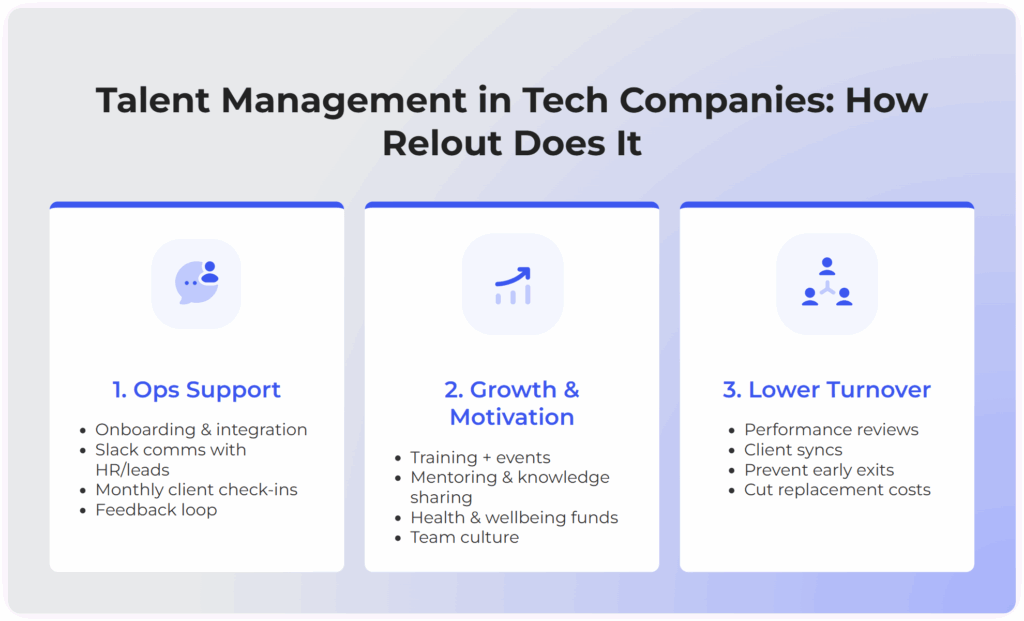
Relout developed its Talent Management approach as part of a broader model for working with external technology specialists. The model combined sourcing and technical verification with onboarding, feedback, specialist development, engagement, and continuity support.
This was also part of Relout’s Talent as a Service approach, in which access to IT specialists was combined with ongoing support after they joined the client environment.
What does TaaS add? Talent as a Service can extend talent acquisition beyond sourcing and verification by including onboarding, ongoing specialist support, retention, replacement or continuity processes, and flexible team scaling. The term is not universally standardized, so the exact scope varies between providers.
Pillar 1: Operational Support and Reducing Client Workload
The operational layer of Relout’s Talent Management model included:
- Onboarding and team integration
- Regular communication between specialists, project stakeholders, and delivery management
- Early identification of issues before they became larger delivery or collaboration problems
- Regular client check-ins and escalation paths
- Gathering feedback from both the client and specialist

Pillar 2: Helping Specialists Grow and Stay Engaged
Relout’s model also included practices designed to support long-term specialist development and engagement, such as:
- Access to industry events
- Learning and development support through courses, books, certifications, and specialist events
- Wellbeing initiatives aimed at supporting sustainable long-term performance
- Equipment support appropriate to the specialist’s working environment
- Support for business travel where onsite collaboration was required
The broader principle is still relevant regardless of the engagement model: specialists are more likely to remain effective over a long project when development, expectations, workload, and communication are actively managed rather than left unattended.

Pillar 3: Reducing Turnover and Continuity Risk
Relout used regular performance reviews, client syncs, specialist feedback, and early escalation to identify problems before they became reasons for an engagement to end.
The objective was not to assume that turnover can be eliminated completely. Some rotation is unavoidable. A mature Talent Management process instead focuses on reducing preventable churn and limiting the delivery impact when a specialist change does occur.
- Retention is supported through better matching, feedback, development, and engagement.
- Continuity is supported through documentation, knowledge transfer, and clear ownership.
- Replacement risk can be reduced when skill requirements and project context are already understood.
What Did the Feedback Process Look Like in Relout?
Feedback was designed to work in both directions. Specialists received input from the client and Delivery Manager and could also raise their own needs, risks, and observations. Regular communication helped identify delivery or collaboration problems before they escalated.
This principle is important in external team models because the client often sees delivery performance while the provider may have additional visibility into engagement, development needs, workload, or potential rotation risk. Combining both perspectives creates a more complete picture.
How Talent Management Supports HR and CTO Teams
Talent Management can reduce the operational burden on internal HR and technology leaders by creating a clear process for onboarding, feedback, development, communication, and continuity.
This becomes particularly relevant when external specialists work inside an existing technology organization. The CTO or engineering leadership still needs to own technical direction and project priorities, but the talent lifecycle does not have to depend entirely on internal recruitment and HR capacity.
For organizations that already own delivery but need additional external capabilities, Staff Augmentation at Edge One Solutions provides a model in which specialists join the client’s existing team and work within its processes and priorities.
How Cultural and Collaboration Fit Supports Team Stability
Technical skills alone do not determine whether an external specialist will work effectively with a team. Communication style, ownership, reliability, feedback habits, and the ability to work within the client’s operating model also matter.
Relout supported this layer through onboarding, integration activities, and team sessions such as integration workshops and remote team integration sessions.
How Does Talent Management Support Staff Augmentation and Talent as a Service?
Talent Management, Staff Augmentation, and Talent as a Service describe different layers of working with external technology specialists.
- Talent Management focuses on what happens throughout the specialist lifecycle: onboarding, development, feedback, engagement, performance, and continuity.
- Staff Augmentation is an engagement model in which external specialists join an existing client team while the client retains day-to-day delivery ownership.
- Talent as a Service can combine sourcing and specialist access with a broader talent-support layer such as onboarding, Talent Management, retention, and flexible scaling.
In other words, Staff Augmentation answers the question “How do we add external skills to our existing team?” Talent Management answers “How do we support those specialists once they are working with us?” A broader TaaS model can connect both layers with sourcing and talent continuity.
Practical distinction: finding a strong specialist does not automatically create a stable engagement. Sourcing quality, onboarding, day-to-day collaboration, feedback, retention, and knowledge continuity all affect whether external talent contributes successfully over time.
Talent Management and IT Outsourcing: Different Layers, Not Substitutes
Talent Management and IT outsourcing should not be treated as direct alternatives. They solve different problems.
Talent Management is a people and continuity layer. IT outsourcing is a delivery or cooperation model. Depending on the setup, Talent Management can support specialists working through Staff Augmentation, dedicated teams, Talent as a Service, or other long-running external team models.
Project-based IT outsourcing, by contrast, typically gives the provider greater responsibility for delivering an agreed project, function, or outcome. The vendor may manage the team internally while the client focuses more on objectives, governance, and acceptance criteria.
| Area | Talent Management layer | Project-based IT outsourcing |
|---|---|---|
| Primary focus | Specialist lifecycle, engagement and continuity | Delivery of an agreed project, function or outcome |
| Main question | How do we help specialists remain productive and engaged over time? | How do we transfer responsibility for delivery to a provider? |
| Typical activities | Onboarding, feedback, development, performance and retention | Planning, staffing, project management, delivery and quality assurance |
| Relevant metrics | Time-to-productivity, retention, engagement, continuity and feedback | Scope, milestones, quality, SLA, budget and delivery outcomes |
| Client involvement | Depends on the engagement model | Usually more strategic than operational |
| Knowledge continuity | Focuses on reducing disruption caused by specialist rotation | Usually addressed through documentation, governance and knowledge transfer |
| Can the two coexist? | Yes | Yes |
Important: the right model should be chosen based on ownership. If the client wants to retain direct control over priorities and delivery while adding specialist capacity, Staff Augmentation may be appropriate. If the provider should own an agreed outcome or function, broader IT outsourcing may be a better fit.
Relout’s Talent Management Experience Is Now Part of Edge One Solutions
Relout built its technology talent approach around more than candidate sourcing. Technical verification, onboarding, specialist development, feedback, engagement, and continuity were designed to support longer and more stable cooperation with external IT professionals.
Following Relout’s acquisition, this experience is now connected with Edge One Solutions and its broader technology delivery capabilities.
Depending on the business need, organizations can use different models — from adding individual specialists to an existing team through Staff Augmentation to building dedicated teams or using broader IT outsourcing arrangements.
Need technology specialists without relying only on permanent recruitment?
Explore how Edge One Solutions structures access to external IT specialists, Staff Augmentation and broader technology team delivery.
Talent Management FAQ
Talent Management in IT is a structured approach to onboarding, developing, supporting and retaining technology specialists so their skills and performance remain aligned with project and business needs.
No. HR usually covers a broader range of organizational and administrative responsibilities. Talent Management focuses more specifically on development, performance, engagement, retention and aligning people with business needs.
Talent Management can reduce preventable turnover by improving role fit, onboarding, feedback, development, communication and early identification of problems. It cannot eliminate all rotation, but it can reduce avoidable causes and limit disruption when changes occur.
TaaS stands for Talent as a Service. It is a flexible model that can combine sourcing and access to specialists with technical verification, onboarding, ongoing talent support, retention and team scaling. The exact scope differs between providers.
Talent Management is a people and continuity layer focused on onboarding, development, engagement, performance and retention. IT outsourcing is a cooperation or delivery model in which an external provider takes responsibility for an agreed scope, function or outcome.
Staff Augmentation adds external specialists to an existing client team. Talent Management can support those specialists after they join through onboarding, feedback, development, engagement and continuity processes.
The client usually retains responsibility for day-to-day priorities, backlog and technical direction. The provider may support sourcing, onboarding, administration, specialist communication and other talent-related processes depending on the agreement.
Talent Management can be useful in any organization where technology delivery depends on scarce skills, long-running projects, external specialists or stable engineering teams. Its relevance depends more on the delivery model and need for continuity than on a specific industry.
Useful metrics can include time-to-productivity, retention or rotation, specialist and manager feedback, onboarding effectiveness, development progress and the impact of personnel changes on delivery continuity.