
AI use in job interviews is becoming harder to separate from normal candidate preparation. Candidates can use generative AI to improve a CV, prepare for interview questions, generate code or even receive suggestions while an interview is taking place.
That means employers need a different question. Instead of asking only “Is this candidate using AI?”, ask:
Can this candidate demonstrate the knowledge, judgement and experience required for the role without AI creating a false signal of competence?
This distinction matters because AI assistance is not automatically dishonest. The real recruitment risk appears when a tool replaces knowledge or experience that the candidate is expected to possess, or when a candidate secretly uses assistance that the interview rules explicitly prohibit.
Relout is now part of Edge One Solutions
Relout developed experience in IT Talent Acquisition, candidate verification and technology staffing. Following the acquisition, this experience is now connected with the broader technology talent and delivery capabilities of Edge One Solutions.
“They will use AI anyway. Instead of fighting it, we should check if they use it wisely.” – Krystian Kotynia, Delivery Manager at Relout at the time of the original publication
1. What Is the Difference Between AI Assistance and Cheating in Hiring?
The most useful distinction is not whether AI was involved. It is what role AI played and whether that use complied with the rules of the process.
| Situation | Usually reasonable | Potential problem |
|---|---|---|
| CV and application | Improving grammar, structure or clarity while keeping experience factually accurate | Inventing projects, responsibilities, technologies or results |
| Interview preparation | Practising questions, identifying knowledge gaps and structuring examples | Memorising generated stories about experience the candidate did not have |
| Live interview | Using tools that the employer has explicitly allowed | Receiving undisclosed real-time answers when external assistance is prohibited |
| Technical assignment | Using AI when the rules allow it and being able to explain the resulting work | Submitting generated work the candidate cannot understand, modify or defend |
“Everyone can read. Not everyone reads with understanding. Using AI is the same.” – Kornelia Pytlak, Project Coordinator at Relout at the time of the original publication
The employer should therefore define what AI use is permitted before assessing whether a candidate has broken the rules. A process with no stated AI policy creates unnecessary ambiguity for both sides.
2. Can You Reliably Detect AI Use During a Job Interview?
There is no single behavioural signal that reliably proves a candidate is using AI. Looking away from the camera, pausing before answering, speaking in a structured way or taking notes can all have completely legitimate explanations.
These behaviours may justify asking a better follow-up question, but they should not be treated as evidence of dishonesty.
Important: do not make a hiring decision because somebody looked away from the screen, paused before answering or sounded unusually polished. Verify competence through the content and consistency of the candidate’s answers instead.
The strongest signals appear when the candidate is asked to go deeper.
- They cannot explain why a technical decision was made.
- They cannot describe the constraints around a project they claim to have delivered.
- They struggle when one assumption in the problem changes.
- They cannot distinguish what they personally owned from what the wider team delivered.
- The terminology is correct, but there is little evidence of practical decision-making behind it.
- A take-home solution looks strong, but the candidate cannot modify, debug or defend it during discussion.
Even these are not proof that AI was used. More importantly, however, you do not need to prove AI use to identify a competence gap. If a candidate cannot demonstrate the capabilities required for the position, that is the relevant hiring signal.
Better recruitment principle: verify capability, not browser behaviour. The objective is to determine whether the candidate can reason, make decisions and perform the work required by the role.
3. How Do You Verify That a Candidate Really Has the Required Skills?
The strongest defence against misleading AI-assisted answers is a structured interview that moves from a claim to evidence.
Ask about experience rather than definitions
A definition can be recalled, memorised or generated in seconds. Real project experience is more difficult to reproduce because it contains context, trade-offs and consequences.
Instead of asking:
“What is Infrastructure as Code?”
ask:
“Tell me about an infrastructure change you automated. What was manual before, what did you automate, what went wrong and how did you validate the result?”
Useful follow-up questions include:
- What was the hardest constraint?
- What alternatives did you consider?
- Why did you reject the other options?
- What failed during implementation?
- How did you know the solution worked?
- What part did you personally own?
- What would you change if you did it again?
Test whether the candidate asks for missing context
Senior work rarely consists of answering perfectly specified questions. Experienced specialists often begin by identifying information that is missing.
For example:
Interviewer: “How would you improve the performance of this service?”
Candidate: “What is the current bottleneck? What traffic does it handle? Which latency target matters? What changed recently?”
The quality of the clarifying questions can reveal more about seniority than a textbook answer.
Change the problem during the conversation
After the candidate proposes a solution, change one constraint:
- traffic increases tenfold,
- the budget is reduced,
- the service becomes subject to a stricter availability requirement,
- one technology can no longer be used,
- the team has to migrate an existing legacy system rather than build greenfield.
Then ask what changes. This tests reasoning rather than reproduction of a prepared answer.
“If ChatGPT can answer your interview question and the answer is good enough, then it’s a bad question.” – Gerard Stańczak, CEO of Relout at the time of the original publication
4. How Can Candidates Use AI at Different Stages of Hiring?
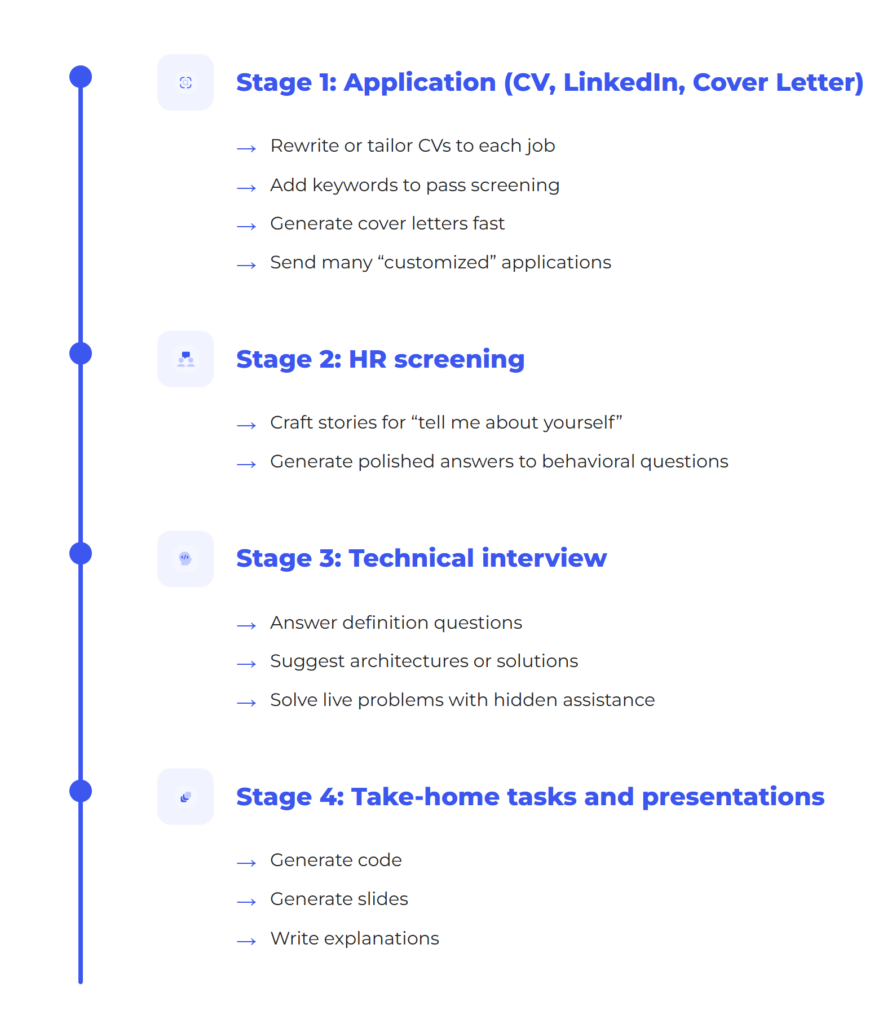
Application stage
Generative AI can help candidates rewrite CVs, tailor applications, prepare cover letters and identify keywords from a job description.
That does not make the application invalid. The verification problem begins when the final document contains experience, responsibilities or achievements that the candidate cannot substantiate.
HR screening
Candidates can use AI to practise behavioural questions or structure examples from their experience. This can improve communication without changing the underlying competence.
The interviewer should therefore follow polished answers with questions about concrete people, decisions, constraints, outcomes and lessons learned.
Technical interview
AI can generate definitions, code, architecture suggestions and debugging ideas. Some tools can also provide assistance while a video interview is running.
Trying to eliminate every possible external tool is unlikely to be a durable recruitment strategy. It is more effective to design questions that require explanation, adaptation and technical judgement.
Take-home assignment
AI can generate substantial parts of code, documentation, analysis or presentation materials. Consequently, evaluating only the submitted artifact provides less information about the candidate than it once did.
The solution should be followed by a discussion in which the candidate explains what they did, which alternatives they considered and how they would modify the work under different constraints.
5. How Should Technical Interviews Change in the AI Era?
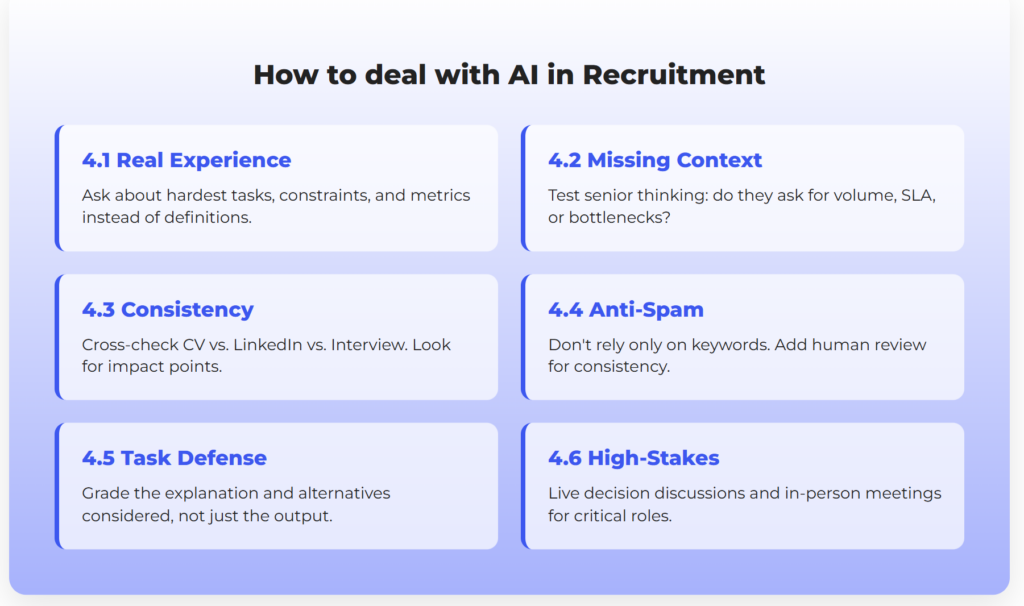
Technical interviews should move away from knowledge-recall questions and toward reasoning under context.
| Weak signal | Stronger verification |
|---|---|
| “Explain SOLID principles.” | “Show me a design decision where following or breaking one of these principles mattered. What trade-off did you make?” |
| “What is Kubernetes?” | “Describe a production problem you handled in Kubernetes. What did you inspect first and why?” |
| “How does caching work?” | “Tell me about a cache you introduced or maintained. How did you handle invalidation and what failed?” |
| “What is DDD?” | “How were domain boundaries defined in one of your projects? Which boundary turned out to be wrong?” |
| “How would you build a scalable API?” | “What information would you need before deciding how this API should scale?” |
The stronger questions do not make AI useless. They make unverified competence harder to hide.
6. How Should Employers Handle AI in Take-Home Assignments?
The first decision is whether AI is allowed. State this explicitly.
If AI is allowed
Consider asking the candidate to disclose how it was used and then evaluate whether they understand the result.
- Which parts were AI-assisted?
- Which suggestions did you reject?
- What did the model initially get wrong?
- How did you validate generated code or assumptions?
- What would you change before putting this solution into production?
This can actually test an increasingly relevant professional skill: using AI without outsourcing judgement to it.
If AI is not allowed
State the restriction before the task starts and explain what kind of assistance is prohibited. A candidate cannot reasonably be expected to follow an unstated rule.
Regardless of the policy, do not grade the artifact alone. Ask the candidate to walk through the solution, modify part of it and respond to a new requirement.
A useful test: if the candidate can explain, challenge, modify and debug the submitted work, the interview reveals considerably more than an attempt to determine whether every line was typed without assistance.
7. What Is “AI Spam” in Recruitment and How Should Employers Respond?
The term “AI spam” is often used for high-volume applications that have been rapidly generated or tailored with AI. Common patterns can include large numbers of similarly worded applications, extensive keyword matching and polished documents with little evidence behind the claims.
None of these patterns proves that an individual candidate lacks the required competence. The operational problem is that application volume can increase while the information value of each application decreases.
Recruitment teams can respond by:
- reducing dependence on keyword matching,
- checking whether important claims contain project context and evidence,
- using short role-specific verification questions,
- reviewing inconsistencies before drawing conclusions,
- keeping job requirements focused on capabilities that actually matter,
- using human review at consequential stages of the hiring process.
Do not replace one weak signal with another
Automatically generated applications can tempt employers to rely on automated filtering or AI-detection scores. That can create another problem: a system generates the application and another system attempts to decide whether the application is genuine.
Automated tools can support triage, but consequential hiring decisions should be based on verified job-relevant evidence. If an organization introduces automated assessment, monitoring or AI-based screening, it should also evaluate privacy, accessibility, fairness and applicable legal requirements before deployment.
8. What Does Current Data Tell Us About AI in Recruitment?
AI-assisted job searching is no longer an edge case.
- A Gartner survey conducted in Q4 2024 among 3,290 job candidates found that 39% had used AI during the application process.
- In the same Gartner research update, only 26% of candidates said they trusted AI to evaluate them fairly, highlighting that employers also need to think about candidate trust when introducing AI into recruitment.
- LinkedIn’s 2026 research reports that 81% of people have used or plan to use AI in their job search, while 48% say AI tools increase their confidence during interviews.
- LinkedIn also reports that the number of US applicants per open role has doubled since spring 2022, increasing the screening challenge for recruitment teams.
The implication is not that employers should become more suspicious of every candidate. It is that traditional signals such as a polished CV, textbook knowledge or an impressive take-home assignment carry less information when viewed in isolation.
The hiring signal is shifting: the value of polished output is decreasing, while the value of verifiable context, judgement, adaptability and ownership is increasing.
9. Create an Explicit AI Policy for the Recruitment Process
A candidate should know what is allowed before an interview or assignment begins.
A simple policy can distinguish between:
| Use case | Example policy |
|---|---|
| CV preparation | AI assistance allowed, but all claims must accurately represent the candidate’s experience. |
| Interview preparation | AI-assisted preparation allowed. |
| Live HR interview | Define whether real-time external answer generation is permitted. |
| Technical interview | Define which tools, documentation and AI assistants can be used. |
| Take-home task | State whether AI is allowed and whether disclosure of AI assistance is required. |
This changes the conversation from trying to infer hidden behaviour to evaluating whether the candidate followed clear rules and demonstrated the required competence.
10. Candidate Verification Checklist for the AI Era
A strong process does not need to prove whether every candidate used AI. It needs to produce enough evidence to make a reliable hiring decision.
- Define AI rules before the assessment.
- Ask for recent, concrete project examples.
- Separate team outcomes from the candidate’s personal contribution.
- Ask about constraints, failures and rejected alternatives.
- Change assumptions during technical discussion.
- Ask the candidate to defend or modify submitted work.
- Check material inconsistencies rather than judging presentation style.
- Do not treat eye movement, pauses or an AI-detector score as proof of cheating.
- Use deeper verification for roles with greater technical, security or operational responsibility.
- Document why the candidate meets or does not meet job-relevant criteria.
Verification Does Not End When the Candidate Is Selected
Even a well-verified specialist still needs project context, access, architecture knowledge and clearly defined responsibilities before becoming productive.
For organizations using external technology talent, Edge One Solutions explains the next stage in How to Onboard an External IT Specialist Into Your Team.
Relout’s IT Talent Experience Is Now Part of Edge One Solutions
Relout developed recruitment and talent-verification practices around technology roles, including evaluating technical fit, experience, communication and the ability to operate in client environments.
Following the acquisition, that experience is now connected with Edge One Solutions and its broader technology delivery capabilities.
For clients using external IT specialists, candidate verification is one part of a wider delivery process. The specialist also needs to match the project context, join the client’s operating model and become productive inside the existing team.
Need external IT specialists whose skills can be verified against your project requirements?
Staff Augmentation allows organizations to add external technology specialists while retaining control over the roadmap, priorities and day-to-day delivery.
AI in Job Interviews: FAQ
Is using AI during a job application cheating?
Not automatically. Using AI to improve wording, organize thoughts or prepare for an interview can be legitimate. The problem starts when a candidate invents experience, submits work they cannot understand or uses real-time assistance that the employer has explicitly prohibited.
How can you tell whether a candidate is using AI during an interview?
There is no single reliable behavioural signal. Eye movement, pauses or highly structured answers should not be treated as proof. A better method is to test whether the candidate can explain decisions, provide project context, respond to follow-up questions and adapt their answer when the problem changes.
Should employers use AI detectors on CVs or interview answers?
An AI-detection score should not be treated as proof that a candidate cheated or lacks competence. Hiring decisions should be based on job-relevant evidence such as verified experience, technical reasoning, consistency and the ability to explain and defend work.
Can candidates use ChatGPT during technical interviews?
That depends on the employer’s assessment rules. If AI tools are allowed, the interview can evaluate how well the candidate uses and validates them. If real-time AI assistance is prohibited, that rule should be communicated before the interview begins.
How can employers verify AI-assisted take-home assignments?
Ask the candidate to explain the solution, identify trade-offs, discuss rejected alternatives, modify part of the work and respond to a new requirement. The ability to understand and adapt the solution is usually more informative than trying to determine whether AI contributed to individual lines of code.
What is AI spam in recruitment?
AI spam generally refers to high-volume AI-assisted applications that can be rapidly tailored to job descriptions. The challenge for employers is not simply the use of AI but the lower signal-to-noise ratio that can result when many polished applications provide little verifiable evidence of experience.
What are the best interview questions in the AI era?
Questions about recent project experience, constraints, trade-offs, failures, personal ownership and changing requirements are usually stronger than pure definition questions. They test applied judgement and make it easier to distinguish memorised knowledge from practical experience.
Should companies ban AI from recruitment entirely?
Not necessarily. The appropriate policy depends on what the assessment is intended to measure. In some roles, effective use of AI may itself be relevant. The important point is to define the rules clearly and ensure the process still verifies the skills and judgement required to perform the job.