
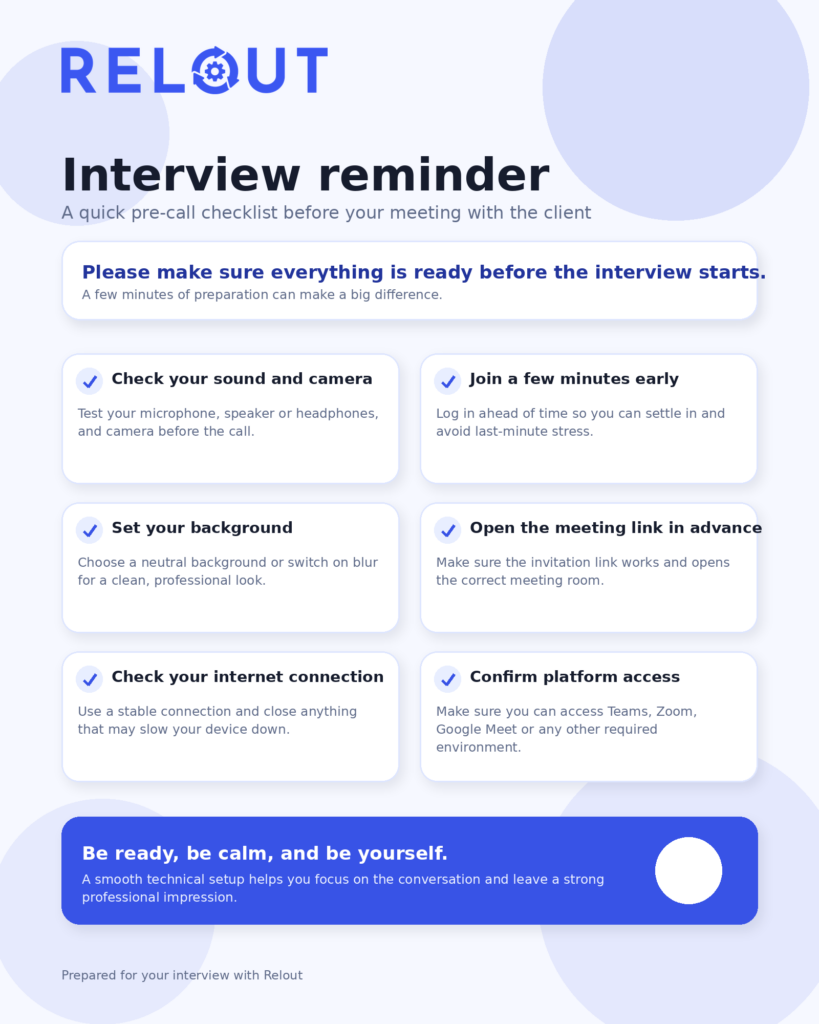
Most interviews are not lost on hard questions. They are lost in the first three minutes – broken audio, a frozen screen, a candidate joining five minutes late.
This guide is the long version of the pre-call checklist we send before every interview. The technical setup first, then the things that actually decide the outcome.
Before the call
These items look trivial. They are not. A strong CV with a dropping mic loses the room before the first question.
Check your sound and camera
Test microphone, speakers or headphones, and camera at least 15 minutes before the call. Not five. If something is broken, you need time to fix it.
- Microphone. Record a 10-second test in the platform you will use. If you sound muffled or echoey, switch to a headset.
- Headphones. Wired beats wireless. Bluetooth headsets fail more often than people expect, especially below 30% battery.
- Camera. Your eyes should sit in the upper third of the frame. A laptop on a desk films you from below – stack books under it to raise it to eye level.
- Lighting. Face a window or a lamp. Never sit with a window behind you – the camera turns you into a silhouette.
Check your internet connection
Run a speed test. You need at least 5 Mbps up and down for stable video. Close backups, file syncs, downloads, and tabs with autoplaying media.
If you live with other people, tell them you have a call. Someone streaming 4K next door can ruin your audio without you knowing.
If your connection is unreliable, have a backup ready. A phone hotspot handles a one-hour video call. Test it before, not during.
Open the meeting link in advance
Open the link 10 minutes before. Two things go wrong here, both fixable in advance:
- The link does not work or opens a different meeting.
- The platform asks you to install, sign in, or update before joining.
If the interview is on a platform you have never used, do a test call with a friend the day before. Teams, Zoom, and Google Meet each have their own quirks around mic permissions, virtual backgrounds, and screen sharing.
Confirm platform access
If the interview needs anything beyond a video call – screen sharing, a coding pad, a take-home environment, a corporate VPN – make sure it works before the call starts. Ask the recruiter if you are not sure what to expect.
Common surprises: coding environments that require a specific browser, corporate VPNs that block standard meeting tools, two-factor authentication on accounts you have not used in months.
Set your background
You do not need a perfect home office. You need a background that does not distract from what you are saying.
Three options that work: a plain wall, a tidy bookshelf, or a neutral blur. What does not work: an unmade bed, dishes, family photos with readable text, or someone walking in the frame. Lock the door if you can.
Join a few minutes early
Two to three minutes before the start time. Not earlier – the interviewer may still be in another call. Not later – being on time means being in the room when the call starts.
Don’t use AI
Do not have ChatGPT, Claude, or any other model open in another window and read answers off it. Interviewers notice.
Using AI to prepare before the call is fine – draft your project stories, rehearse answers, generate questions to ask. Using it live is a fast way to get marked as “no”. A wrong answer in your own words is recoverable. A correct answer that clearly is not yours is not.
During the call
Once the setup works, the substance starts.
Prepare context, not answers
You do not need memorised answers. You need to walk in knowing three things:
- What the company does. The product, the customers, the market. Not the marketing copy.
- What the role is. Read the job description and identify the two or three skills that matter most.
- Your own story. Three to five concrete projects. What the problem was, what you did, what the outcome was, what you would do differently now.
If you cannot answer “why this company, why this role” in two sentences, you are not ready.
Answer the question that was asked
The most common mistake is answering the question you wish you were asked.
If the question is “tell me about a time you handled a conflict with a teammate”, do not pivot to a story about technical excellence. Answer the actual question. If you do not have a good example, say so and offer the closest one you have.
A question about a past project is rarely about the project. It is about how you think, communicate, and work with others.
Be specific
Vague answers sound rehearsed and reveal nothing. Compare:
- “I led a team to deliver a major project on time.”
- “I led four engineers to migrate our payment system off Stripe to Adyen in 11 weeks, with zero downtime during the cutover. The hardest part was reconciling subscription states between the two providers.”
Numbers, names, dates, decisions. That is what makes a story credible.
Ask your own questions
If you do not ask anything, you signal that you have not thought about the role seriously. Generic questions (“what is the culture like?”) are filler. Specific questions show you were listening.
Examples that work:
- “You mentioned moving from a monolith to services. Where are you in that migration, and what is the hardest part right now?”
- “What does success look like for this role in the first six months?”
- “What is the team struggling with that you hope this hire will help with?”
If the interviewer cannot answer your questions clearly, that is information for you too.
Do not bluff
If you do not know something, say so. Then say what you would do to find out.
“I have not worked with Kafka, but I have used RabbitMQ for similar use cases. The concepts overlap – I would expect a few weeks to get comfortable.”
That beats improvising a wrong answer. Senior interviewers spot bluffing within seconds. It is the fastest way to lose credibility.
The quick checklist
If you remember nothing else:
- Check your sound and camera – 15 minutes before, not five.
- Check your internet connection – stable, nothing else hogging the bandwidth, hotspot ready.
- Open the meeting link in advance – confirm it works and the platform loads.
- Confirm platform access – Teams, Zoom, Meet, coding pads, VPN, whatever the call requires.
- Set your background – plain wall, tidy room, or a clean blur.
- Join a few minutes early – two to three minutes, no more, no less.
A smooth setup will not win you the job. A broken one will lose it before you have said a word. Get the boring stuff right, then focus on the conversation.
Be ready, be calm, be yourself.
At Relout we match engineers with companies that respect both sides of the table. If you are preparing for an interview through us, this checklist is part of how we make sure the call is about the work, not the wiring.