Many companies outsource to grow their development teams, and nearshoring is a practical option.
If you want to nearshore IT to Poland from another European country, the good news is that most of the core mechanics are the same across Europe (because Poland is in the EU/EEA).
Below is a general playbook on nearshoring IT to Poland.
| Key Takeaways: 1. Nearshoring to Poland offers time zone alignment, strong talent pool, and EU regulatory simplicity. 2. Poland remains cost-effective compared to Western Europe. 3. Clarify IP ownership, on-call responsibilities, and access levels in contracts. 4. Ensure GDPR, VAT, and security rules are standardized before launch. |
What is nearshoring in software development?
Nearshoring is the practice of outsourcing software development to nearby countries that share similar time zones, cultures, and work ethics. For European tech companies, this often means partnering with teams in Central or Eastern Europe, especially Poland.
Nearshoring avoids many of the headaches that come with offshoring to faraway countries. With fewer time zone gaps and better cultural fit, communication is faster, collaboration feels smoother, and teams can deliver higher-quality work with far less friction.
Learn more about nearshoring here: What is nearshoring?
How to nearshore IT to Poland
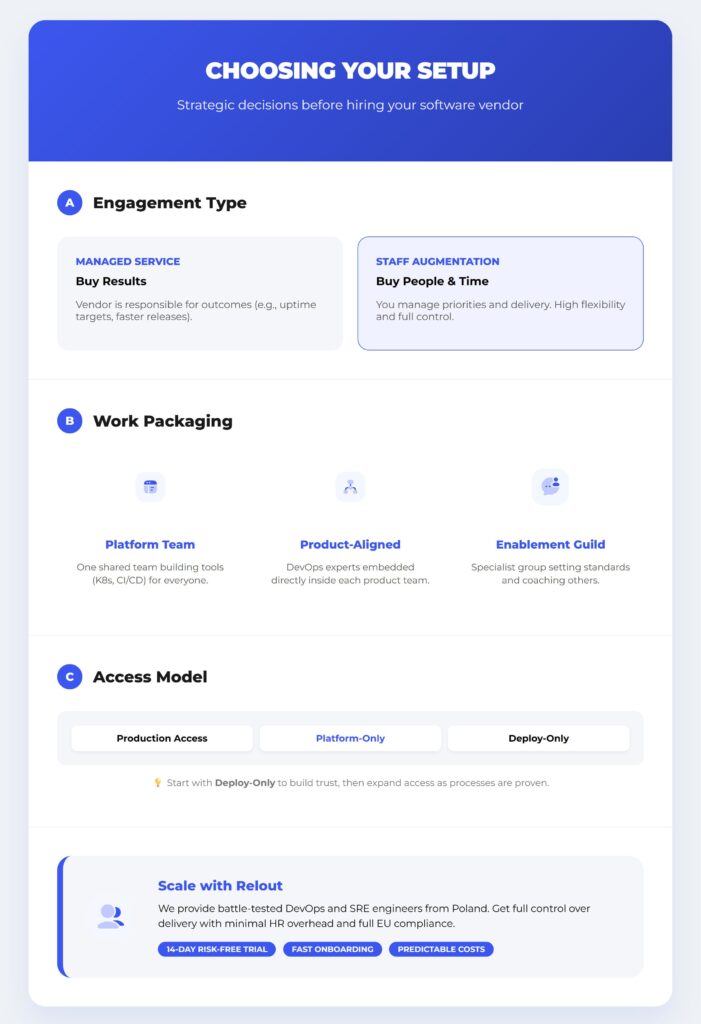
Below we present a few things to have in mind before you choose your software vendor.
1) Decide “how we will work”
Think of this as choosing your setup first, so any vendor/team you pick can plug into it.
A. Engagement type (how you buy the work)
- Managed service = you buy results (e.g., uptime targets, faster releases). Vendor is responsible for outcomes.
- Staff augmentation = you buy people/time (e.g., 2 DevOps engineers). You manage priorities and delivery.
Relout can help you with staff augmentation. We provide top-tier DevOps and SRE engineers from Poland with fast onboarding, predictable monthly costs, and no hidden fees. You’ll get a 14-day risk-free trial, guaranteed replacements, and full control over delivery – all with minimal HR overhead and full EU compliance.

B. Work packaging (how you organize the work)
Before choosing a vendor, it’s important to think about how DevOps work will be structured in your organization. Even if you’re starting with just one team, choosing the right packaging model sets the tone for future growth.
There are three common ways to place DevOps work:
- Platform team (one shared team)
A Poland team builds shared tools used by everyone (CI/CD templates, Kubernetes platform, Terraform modules, monitoring).
Best when you have many teams and want consistency. - Product-aligned DevOps (DevOps inside each product team)
DevOps people sit with each product team and focus on that product’s pipelines and production reliability.
Best when each product is different and needs fast day-to-day support. - Enablement guild (shared experts)
A small specialist group helps multiple teams by setting standards, coaching, reviewing, and building reusable pieces.
Best when you need expert help but not full ownership.
C. Access model (what the Poland team is allowed to touch)
- Production access: they can log into prod and fix things directly. Fast, but needs strong security controls.
- Platform-only: they manage shared platforms (clusters/pipelines), but not app-level prod data/systems.
- Deploy-only: they can deploy via pipelines, but can’t log into prod directly. Lowest risk, slower for incidents.
If your organization is cautious, start with deploy-only and expand later once trust/processes are proven.
D. Support model (how incidents are handled)
Decide and document:
- Who is on-call
- Which hours are covered (business hours vs 24/7)
- Who escalates to whom
- Who writes post-incident reports and owns fixes
PM tip: On-call ambiguity is one of the biggest causes of friction in nearshoring.
2) Standardize the backbone
You want one standard “package” for agreements and security rules.
A common setup:
- One master contract (MSA – Master Services Agreement) with the Poland provider (the overall rules)
- One SOW (Statement of Work) per country/team (what exactly is delivered, who is assigned, rates, timelines)
- One security document (access, logging, incident reporting, SDLC requirements)
- One GDPR/DPA template (data protection rules), with small local add-ons if required
3) Tax/VAT: usually not your main problem, but finance must handle it correctly
Inside the EU, cross-border B2B services commonly use reverse charge VAT (your finance team accounts for VAT on your side).
It gets more complex when:
- Some countries involved are non-EU (UK, Norway, Switzerland)
- You accidentally set up something that looks like a “permanent” business presence in Poland
PM tip: You don’t need to master VAT. You need to ensure finance is engaged early and your vendor invoices correctly.
4) GDPR/data: treat it as “EEA vs non-EEA”
Simplify the compliance picture like this:
- If the data stays within the EEA (EU + Iceland, Liechtenstein, Norway), it’s generally simpler from a “cross-border transfer” perspective.
- If data goes outside the EEA, extra legal mechanisms may be needed (depending on the country).
Even if it’s legally simpler, DevOps can see logs and production systems–so handle it as “privileged access,” not as low-risk outsourcing.
5) IP ownership: make sure you actually own what the Poland team creates
This matters because the Poland team will create:
- Infrastructure code (Terraform)
- Scripts, pipelines
- Documentation/runbooks
You need contracts that clearly say:
- The code and materials created for you become your IP (or you get an exclusive license)
- When the transfer happens (often “after acceptance/payment”)
Do not assume “we paid, so we own it.” Make it explicit in the paperwork.
6) The most common nearshoring failures (non-legal)
These are “PM land,” and they’re the reasons programs struggle:
- Unclear ownership: Who owns reliability? Cost? Incident communications?
- On-call not designed: Who responds at 2am? Is it business hours only?
- Security/compliance not embedded: DevOps makes frequent changes–controls must be lightweight but real.
- Tooling chaos: Different pipelines/tools per team leads to permanent inefficiency.
- Weak knowledge transfer: Nobody documents; you can’t run without the vendor.
Make documentation/runbooks part of “done,” not optional.
Why Poland
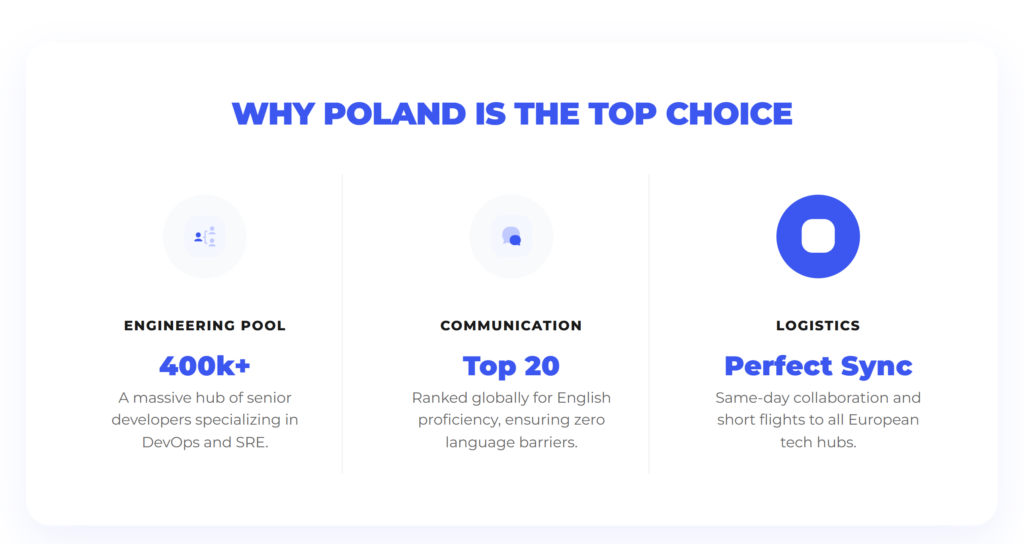
Poland is a strong default for nearshoring within Europe, but whether you “should go somewhere else” depends on what you are optimizing for: scale, cost, language/time zone, regulatory simplicity, and risk diversification.
Why is Poland a top destination for nearshore teams?
Poland is not just a cost-effective market–it’s a strategic tech hub. Here’s why it stands out:
- Over 400,000 software developers
- Ranked high in English proficiency
- Strong STEM education system
- EU regulations, data privacy alignment, and political stability
- Short flights and overlapping work hours with Western Europe
Cost level (EU-benchmarkable)
A useful baseline is Eurostat hourly labour costs (whole economy, enterprises 10+ employees. Important: these are NOT developer rates). For 2024:
| Geography | Hourly labour cost, 2024 (€ / hour) | Notes |
| Romania | 12.5 | Lower-cost EU nearshore benchmark |
| Hungary | 14.1 | Lower-cost EU nearshore benchmark |
| Poland | 17.3 | Mid-cost CEE benchmark |
| Czechia | 18.2 | Similar band to Poland |
| Portugal | 18.2 | Similar band to Poland/Czechia |
| Spain | 25.5 | Higher-cost nearshore alternative |
| EU average | 33.5 | Reference point (EU mean) |
Interpretation: Poland is no longer “ultra-cheap,” but it remains materially cheaper than Western Europe and competitive versus some nearshore alternatives (e.g., Portugal), while offering more scale than smaller markets.
Talent scale and ecosystem (practical availability)
Poland’s key advantage is usually depth and breadth of the IT services ecosystem (multiple large cities, many vendors, and mature delivery patterns). Eurostat also documents the long-run growth of ICT specialists across the EU and the structural demand for these roles.
If you plan to nearshore multiple teams (not just a small DevOps pod), Poland and Romania are typically the two EU markets that can absorb sustained demand with less fragility.
Operational fit for multi-country Europe
Poland is in the EU (and Schengen), and its main hubs sit in CET/CEST, which aligns well for most continental European countries. For multi-country governance, EU membership reduces friction (VAT handling, GDPR alignment, travel, contracting patterns).
Integration with the team is easier. For example, our client from Scandinavia flies to Gdańsk in 50 or 55 minutes… possessing your own hub in Gdańsk or outsourcing a team from Gdańsk is practically a stone’s throw away and virtually imperceptible. – Krystian Kotynia, Delivery Manager at Relout
When Poland is the right answer
Choose Poland as your primary hub when you need:
- Scale (multiple teams / long runway for hiring)
- Mature vendor landscape (bench strength, replacement capacity, domain specialists)
- CET alignment for stakeholder-heavy work across continental Europe
- A strong “middle ground” between cost and quality/availability
Want to compare your options?
Would you like a quick breakdown of how a Polish nearshore team would integrate into your sprint cycle compared to your current setup? We’re happy to show you the difference it makes when everything just clicks.
FAQ: Nearshoring IT to Poland
1. How do you nearshore IT services to Poland?
To nearshore IT to Poland, follow these steps:
- Choose an engagement model
- Define work packaging
- Set access levels
- Clarify support mode
- Standardize agreements
- Align finance and tax
- Ensure data compliance
- Secure IP ownership
- Plan for operational pitfalls
2. What are the main engagement models for nearshoring IT to Poland?
There are three primary models:
- Managed Service – You buy outcomes; the vendor owns delivery. (You hire through an agency like Relout).
- Staff Augmentation – You buy people/time; you manage delivery. (You hire through an agency like Relout).
- Captive Center – You hire directly in Poland; you control all aspects.
3. What should be included in a nearshoring contract with a Polish vendor?
A strong contract setup includes:
- Master Services Agreement (MSA)
- Statement of Work (SOW) per team/country
- GDPR/Data Processing Agreement
- Security requirements (access, logging, incident handling)
- IP ownership terms with clear transfer timing
4. How does GDPR affect nearshoring IT to Poland?
If your data remains within the EEA, GDPR compliance is simpler. However, access to production logs and systems should be treated as privileged, requiring robust security controls.
5. What are common mistakes when nearshoring DevOps teams?
Some of the most frequent issues include:
- Unclear ownership of systems and incidents
- Lack of on-call structure
- Weak documentation and knowledge transfer
- Tooling inconsistency across teams
- Insufficient security integration in daily workflows
6. Why is Poland a good destination for nearshoring IT?
Poland offers a strong tech talent pool, EU data compliance, cost-effectiveness, and time zone alignment with Western Europe. With over 400,000 developers and mature IT vendors, it supports scalable, long-term nearshore setups.
7. How much does IT labor cost in Poland compared to other EU countries?
As of 2024, average hourly labor costs in Poland are €17.3. This is lower than Western Europe (e.g., Spain €25.5, EU average €33.5), but higher than Romania (€12.5) and Hungary (€14.1), offering a middle ground of cost and quality.
8. Do I need to worry about VAT when nearshoring IT to Poland?
For most EU-to-Poland B2B services, reverse-charge VAT applies, meaning your local finance team accounts for the VAT. Complexity increases if non-EU countries are involved or if your setup resembles a permanent establishment.
9. What access should a nearshore DevOps team in Poland have?
Typical access models include:
- Deploy-only – Low-risk, slower incident response.
- Platform-only – Manages shared systems, not app-level prod.
- Full production access – Fast fixes, but needs strict controls.
Start with limited access and expand as trust grows.
10. Who owns the IP when software is developed by a Polish vendor?
You must define IP ownership in your contracts. Ensure the agreement states that all code, scripts, and documentation created for you either:
- Become your intellectual property, or
- Are licensed to you exclusively upon delivery or payment.
11. Is nearshoring better than offshoring for European companies?
Yes, for many companies. Nearshoring to countries like Poland reduces time zone friction, improves communication, and aligns with EU regulations–making it easier to collaborate and manage security, data, and compliance.