
Nearshoring is a delivery model in which a company outsources technology work to a geographically nearby country, usually with substantial working-hour overlap. The goal is to gain access to external skills or delivery capacity while keeping real-time collaboration, travel and coordination relatively easy.
Nearshoring can be used for software development, QA, data, cloud, DevOps and other technology capabilities. It describes where external delivery takes place rather than exactly how the commercial relationship is structured.
This distinction matters. A nearshore team can work through Staff Augmentation, a dedicated team, project outsourcing or a managed service. The location model and the engagement model are related decisions, but they are not the same thing.
Relout is now part of Edge One Solutions
Relout developed experience in sourcing and supporting technology specialists for distributed teams. Following the acquisition, this experience is now connected with the broader Nearshore & Offshore and technology delivery capabilities of Edge One Solutions.
Nearshoring vs onshoring vs offshoring
The difference between onshoring, nearshoring and offshoring is primarily geographical. The terms describe where external work is performed relative to the client.
| Model | Where the work is delivered | Typical time-zone relationship | Main trade-off |
|---|---|---|---|
| Onshoring | In the same country as the client | Usually identical working hours | Maximum geographic proximity, but often a narrower domestic talent market |
| Nearshoring | In a nearby country or region | Usually substantial working-hour overlap | Balances access to external talent with real-time collaboration |
| Offshoring | In a more distant country or region | Potentially significant time-zone difference | Can broaden global talent access but may require more structured asynchronous delivery and handoffs |
None of these models is inherently better. The right choice depends on the work being outsourced, collaboration requirements, skill availability, security and compliance requirements, delivery hours and the operating model of the organization.
What are the benefits of nearshoring?
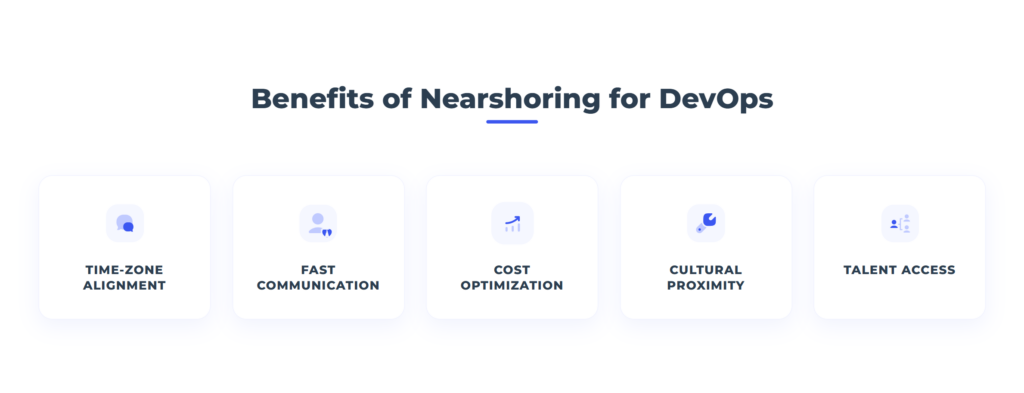
- Working-hour overlap: internal and external teams can usually participate in standups, workshops, planning and problem solving during the same working day.
- Faster communication: questions can be resolved in real time instead of waiting for the next working day in another region.
- Access to a broader talent pool: companies can source technology skills beyond their domestic market without necessarily moving delivery to distant time zones.
- Easier onsite collaboration: geographic proximity can make workshops, kick-offs and periodic team meetings easier to organize.
- More operating-model options: nearshoring can support individual specialists, embedded teams, dedicated teams and managed delivery.
- Cost optimization potential: nearshoring can support a more efficient total delivery cost when talent availability, onboarding, management, collaboration, travel and continuity are considered together rather than comparing hourly rates alone.
Nearshoring offers a better time to market and understanding of the market… because culturally we are similar or the same. – Krystian Kotynia, Delivery Manager at Relout at the time of publication
Geographic and cultural proximity can reduce collaboration friction, especially when teams share similar working hours and can meet in person when needed. However, effective nearshore cooperation still depends on clear communication standards, onboarding, defined responsibilities and agreed ways of working.
What are the disadvantages of nearshoring?
Nearshoring reduces some of the friction associated with distributed delivery, but it does not remove the risks of outsourcing.
- Cost advantage is not automatic. Nearshoring can support cost optimization, but the business case should be evaluated using total delivery cost rather than hourly rates alone. Seniority, scarce skills, onboarding, management, rotation and project requirements all affect the final economics.
- Vendor quality still matters. Geography cannot compensate for weak technical verification, unstable teams or poor project governance.
- Knowledge can still become concentrated externally. Documentation, architecture decisions and handover processes remain necessary.
- Security and data-access risks remain. External specialists may require access to source code, cloud environments, production systems or business data.
- Legal and contractual requirements still need attention. IP rights, data processing, security obligations and commercial responsibilities must be clearly defined.
- Working-hour overlap does not solve unclear ownership. Teams can still struggle if decision rights, priorities, escalation and accountability are not explicit.
Key distinction: nearshoring addresses location and collaboration. Delivery quality still depends on the provider, operating model, talent quality, governance, security and knowledge management.
Why does nearshoring work well for DevOps and SRE?
Nearshoring can be particularly useful for DevOps and Site Reliability Engineering (SRE) because these roles often require more real-time interaction than isolated development tasks.
DevOps and SRE specialists may participate in deployment windows, incident response, architecture discussions, infrastructure changes, platform operations and on-call rotations. Significant working-hour overlap therefore makes coordination easier.
- Incident response: specialists can troubleshoot problems together instead of relying entirely on asynchronous handoffs.
- Change windows: infrastructure and production changes can be coordinated with internal engineering and business teams.
- Platform collaboration: DevOps engineers can work directly with developers, security specialists and architects.
- Knowledge transfer: architecture discussions, reviews and operational learning can take place during shared working hours.
Which regions are commonly used for nearshoring?
The definition of “near” depends on where the client is located. A destination that is nearshore for a German company may be offshore for a company in California.
Nearshoring for North American companies
US and Canadian organizations commonly look toward Latin America when working-hour overlap is a priority. Depending on the client’s location and requirements, potential markets can include Mexico and countries in Central or South America.
The relevant comparison should not be based on a country ranking alone. Buyers should verify the availability of the required technology skills, language requirements, time-zone alignment, employment or vendor structure, data-access requirements and the provider’s ability to scale.
Nearshoring for European companies
European organizations often consider Central, Eastern and Southern Europe. Depending on the client’s location and project, countries such as Poland, Romania, Czechia, Portugal or the Baltic states may provide substantial working-hour overlap and relatively easy travel.
For European buyers, EU or EEA delivery may also be relevant to procurement, governance and data-protection requirements, although the actual compliance obligations still depend on the project and data-processing model.
Do not choose a nearshore destination from a generic ranking. Compare locations against the specific role, technology stack, seniority, working hours, language requirements, security constraints, travel expectations and required scale.
Is nearshoring the same as Staff Augmentation or IT outsourcing?
No. Nearshoring describes location. Staff Augmentation and broader IT outsourcing describe how the external delivery relationship and responsibilities are organized.
| Concept | What it describes |
|---|---|
| Nearshoring | Where the external team or specialist is located relative to the client. |
| Staff Augmentation | External specialists join the client’s existing team while the client retains day-to-day delivery ownership. |
| IT outsourcing | The provider takes responsibility for an agreed project, function, service or delivery scope. |
A nearshore engagement can therefore use different delivery models. If the organization mainly needs additional specialists inside an existing technology team, see Staff Augmentation at Edge One Solutions.
DevOps delivery models that work with nearshoring
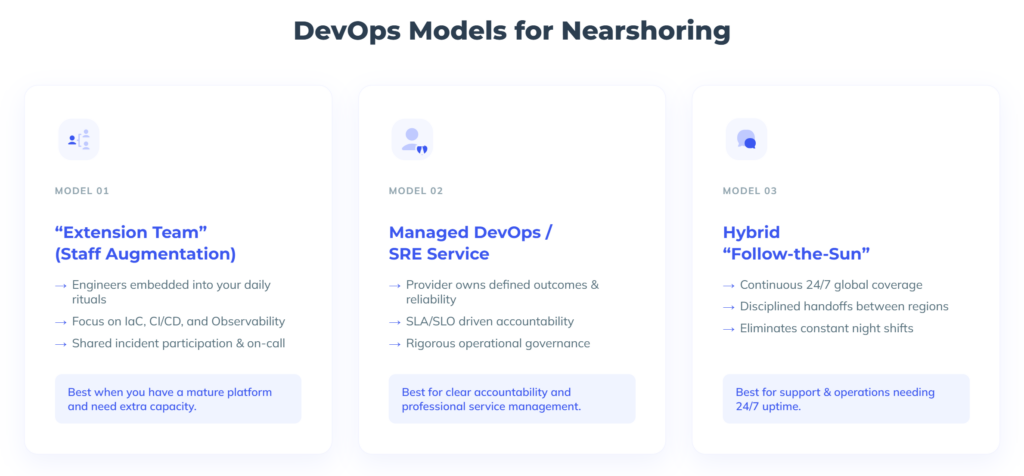
1. Extension team
The client retains architecture and delivery ownership while external specialists work inside its existing engineering processes.
- Infrastructure as Code
- CI/CD
- cloud engineering
- observability
- platform engineering
- incident participation
This model is most suitable when the organization already has technical leadership and primarily needs additional specialist capacity.
2. Managed DevOps or SRE service
In a managed model, the provider owns a defined scope of responsibility rather than simply adding people to the client’s team.
That may include agreed responsibilities around platform operations, reliability, incident response or deployment infrastructure. Because the provider owns more of the outcome, the contract and governance model need to be correspondingly clearer.
3. Multi-region or follow-the-sun delivery
Organizations that genuinely require extended or 24/7 coverage can distribute responsibilities across more than one region. A nearshore team can cover the client’s primary operating hours while another team covers a different part of the day.
This is different from simply asking one nearshore team to work permanent night shifts. A multi-region model can reduce dependence on unsustainable working hours, but it requires disciplined handoffs, documentation and clear incident ownership.
For a North American company, for example, a LATAM team may be considered nearshore while a Poland-based team would normally be an offshore component of a broader multi-region delivery model. The same country can therefore represent a different sourcing category depending on where the client is based.
What should be defined before nearshoring DevOps?
DevOps nearshoring becomes risky when the external team starts working before operational responsibility has been defined.
- On-call responsibility: covered hours, paging policy, escalation paths and responsibility levels.
- SLIs, SLOs and relevant service metrics: how reliability and operational quality will be evaluated.
- Access controls: least privilege, privileged access, audit logging and break-glass procedures where required.
- Change management: deployment rules, approvals, change windows and rollback procedures.
- Incident management: severity definitions, communication ownership, escalation and post-incident review.
- Runbooks and documentation: which operational artifacts must be maintained and who owns them.
- Security and compliance: data access, incident reporting, confidentiality and applicable organizational standards.
- Tooling: cloud platforms, Infrastructure as Code, CI/CD, observability and IT service-management tools used by both teams.
Practical rule: define ownership before access. The question “Who is responsible when production fails?” should be answered before an external DevOps specialist receives production credentials.
When does nearshoring make sense?
Nearshoring is particularly useful when external technology capacity is needed but close day-to-day collaboration remains important.
- your internal talent market does not provide enough of the required skills,
- external specialists need regular interaction with your engineers or business stakeholders,
- working-hour overlap is important for incident response or project decisions,
- you expect periodic onsite workshops or team meetings,
- you want to scale capacity without creating a new local entity or permanent internal team immediately,
- the project requires specialist capabilities that are easier to access in a nearby technology market.
Nearshoring may be less important when the work is highly asynchronous, when the required expertise is concentrated in another global region, or when a follow-the-sun model intentionally relies on larger time-zone differences.
What about nearshoring IT to Poland?
For many European organizations, Poland can function as a nearshore delivery location because it combines European working-hour overlap with access to a developed technology-services ecosystem.
However, choosing Poland is only the beginning. The organization still needs to define the engagement model, system access, on-call ownership, contracts, GDPR responsibilities, security, intellectual property and knowledge-transfer processes.
We cover those implementation decisions separately in How to Nearshore IT to Poland: DevOps Nearshoring Explained.
Why this is a separate guide: this article explains what nearshoring is and when the model makes sense. The Poland guide focuses on how to structure a concrete nearshore engagement, including delivery ownership, DevOps access, on-call, contracts, GDPR and IP.
Relout’s Nearshoring Experience Is Now Part of Edge One Solutions
Relout developed experience in technology talent sourcing, distributed-team cooperation and supporting specialists working across client organizations and locations.
Following the acquisition of Relout, this experience is now connected with Edge One Solutions and its broader technology delivery capabilities.
The appropriate model depends on what the organization actually needs: additional specialists inside an existing team, a larger nearshore team, or a provider that takes responsibility for a broader delivery scope.
Considering a nearshore or offshore technology team?
Edge One Solutions supports organizations that need external technology capabilities through Nearshore & Offshore and related technology delivery models.
Nearshoring FAQ
Nearshoring in IT means outsourcing technology work to a geographically nearby country, usually with substantial working-hour overlap. It can be used for software development, DevOps, QA, data, cloud and other technology capabilities.
Onshoring keeps delivery in the same country as the client. Nearshoring moves delivery to a nearby country with substantial working-hour overlap. Offshoring uses a more distant location and may involve larger time-zone differences.
The main potential benefits are working-hour overlap, faster real-time communication, access to additional technology skills, easier onsite collaboration and the ability to scale external delivery without relying only on the domestic talent market. Nearshoring can also support cost optimization when total delivery cost is considered rather than hourly rates alone.
No. Nearshoring describes where external delivery takes place. Staff Augmentation describes how external specialists join an existing client team while the client retains day-to-day delivery ownership. Staff Augmentation can therefore be delivered in a nearshore model.
DevOps and SRE often require real-time collaboration around incidents, deployment windows, infrastructure changes and platform operations. Working-hour overlap can make these activities easier to coordinate across internal and external teams.
It depends on where the client is based. Poland can function as a nearshore location for many European organizations because working hours substantially overlap and travel is relatively convenient. For a North American company, Poland would normally be considered an offshore rather than nearshore location.
It can, but the comparison should use total delivery cost rather than hourly rates alone. Talent availability, seniority, onboarding, management, specialist rotation, travel, communication overhead and knowledge transfer can all affect the final business case.
A follow-the-sun model distributes operational responsibility across teams in different time zones so that another team can continue work or support as one region ends its working day. It can provide extended coverage but requires disciplined handoffs, documentation and clear ownership.