
In a world where almost every company builds products and processes on technology, the biggest limitation is often access to people and skills.
In practice, you’ll most commonly see three cooperation models: outsourcing, staff augmentation, and body leasing. Each offers a different balance of control, accountability, and speed of scaling.
How do outsourcing, staff augmentation, and body leasing differ?
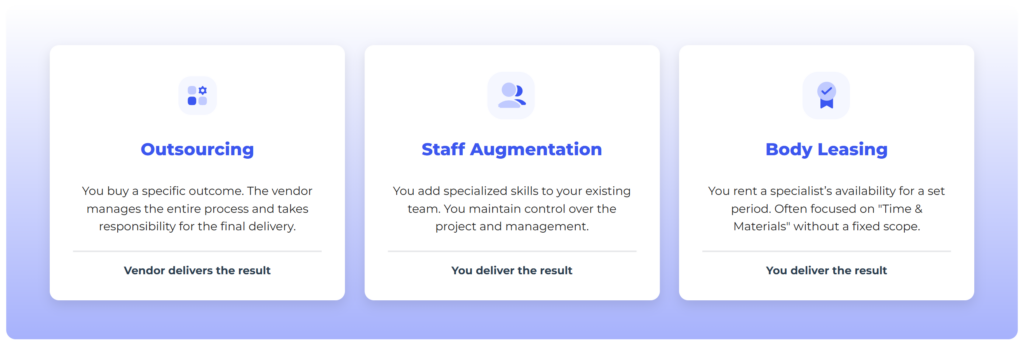
In simple terms:
- Outsourcing – you buy an outcome (the vendor delivers the result).
- Staff augmentation – you add skills to your team (you deliver the result).
- Body leasing – you rent a specialist’s availability for a period (you deliver the result, often in a “time & materials” model).
“Outsourcing is full responsibility for the process and the result… In body leasing, the client manages the work… Staff augmentation is an extension of an existing team, usually at a larger scale and for a longer horizon.” – Krystian Kotynia, Delivery Manager at Relout
What is IT outsourcing?
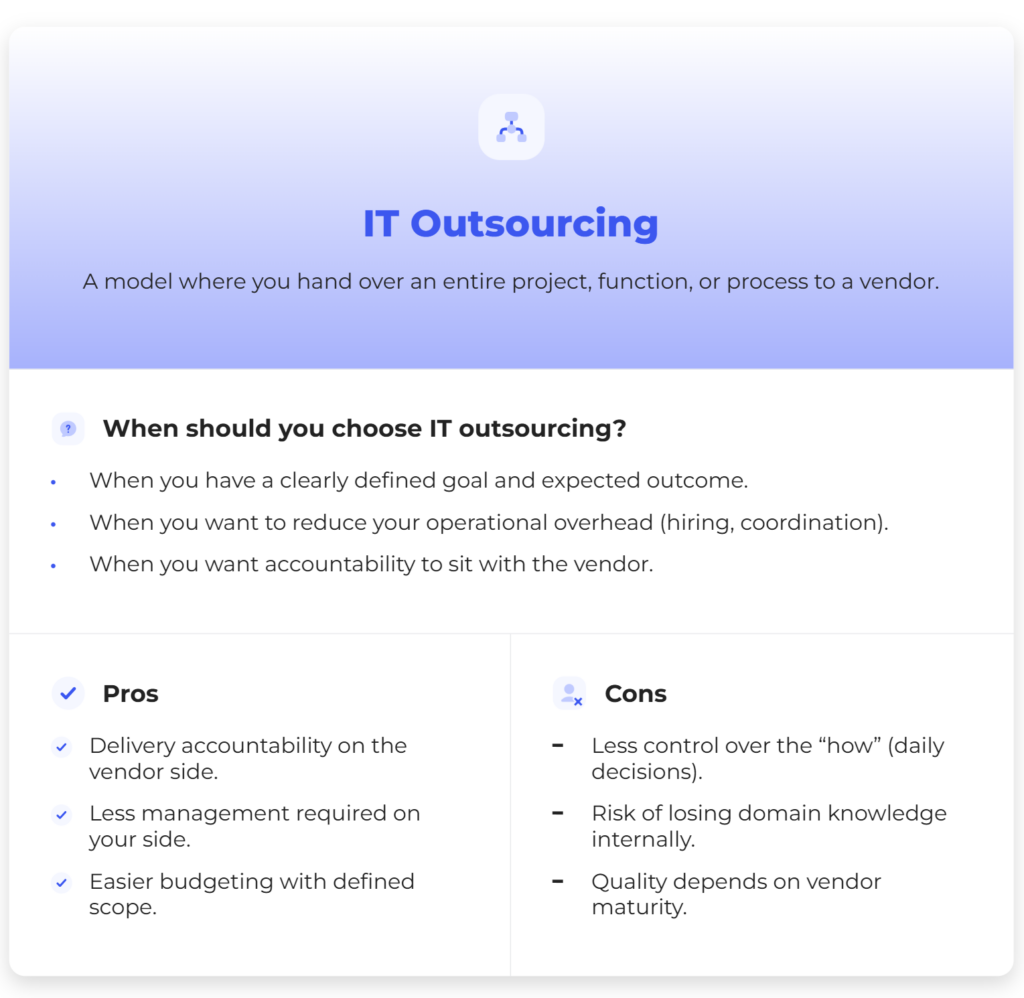
IT outsourcing is a model in which you hand over an entire project, function, or process to a vendor (e.g., building an app, maintaining a system, developing a module). The vendor is responsible for staffing, management, and delivering the agreed scope.
When should you choose IT outsourcing?
- when you have a clearly defined goal and expected outcome,
- when you want to reduce your operational overhead (people management, hiring, day-to-day coordination),
- when you want accountability to sit with the vendor.
Pros of outsourcing
- delivery accountability on the vendor side,
- less management required on your side,
- easier budgeting (especially with well-defined scope).
Cons of outsourcing
- less control over the “how” (process and day-to-day decisions),
- risk of losing domain knowledge internally if you don’t ensure knowledge transfer,
- quality depends heavily on vendor maturity and contract design.
What is staff augmentation?
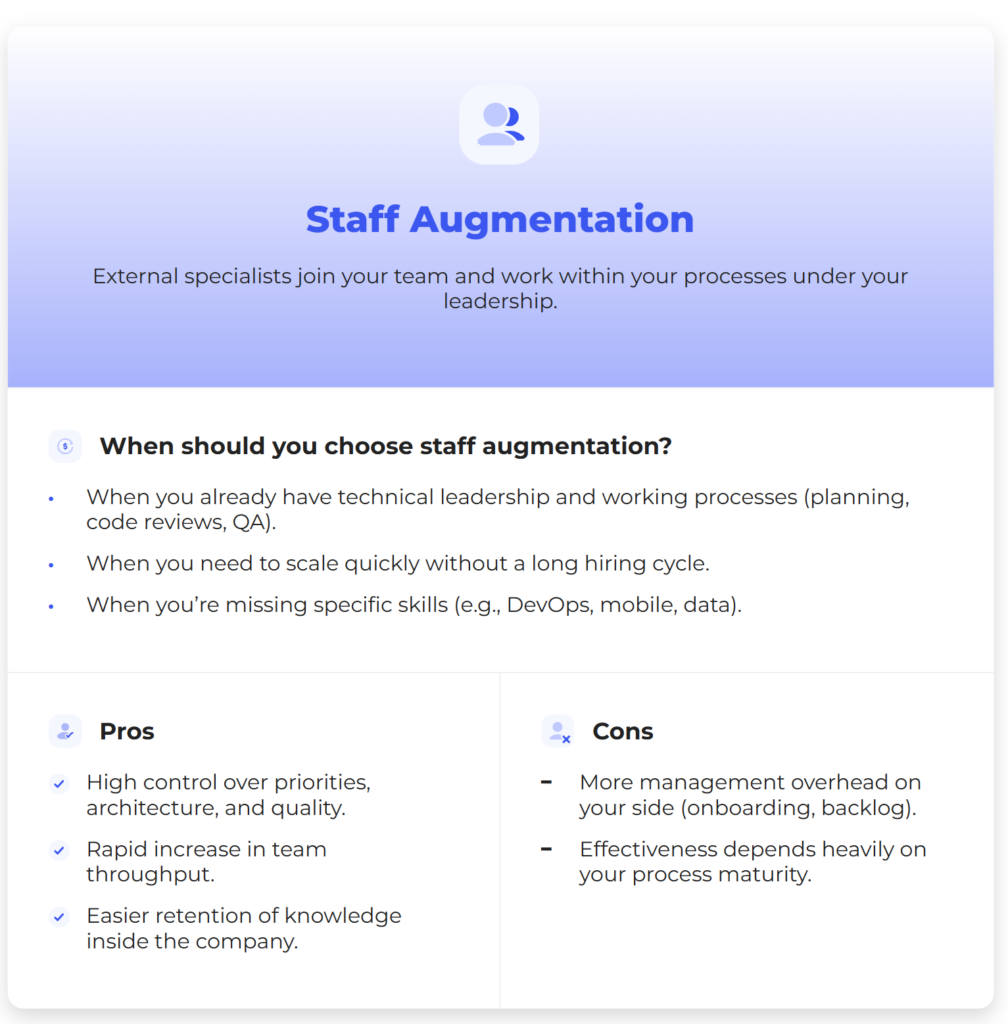
Staff augmentation means external specialists join your team (remotely or on-site) and work within your processes, under your leadership. The goal is to quickly fill skill gaps or increase delivery capacity.
When should you choose staff augmentation?
- when you already have technical leadership and working processes (planning, code reviews, QA),
- when you need to scale quickly without a long hiring cycle,
- when you’re missing specific skills (e.g., DevOps, mobile, data).
Pros of staff augmentation
- high control over priorities, architecture, and quality,
- rapid increase in team throughput,
- easier retention of knowledge inside the company (because work happens “within” your team).
Cons of staff augmentation
- more management overhead on your side (communication, backlog, onboarding),
- effectiveness depends on your process maturity (especially onboarding and documentation).
What is body leasing?
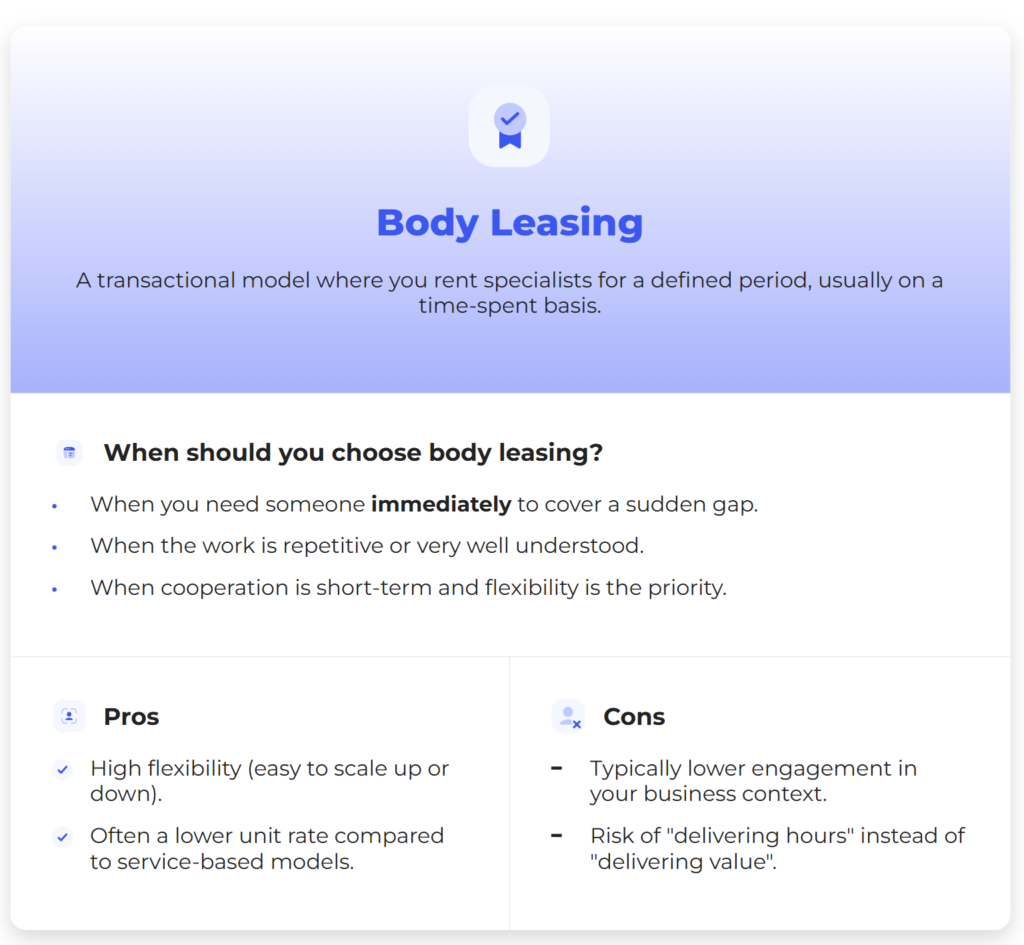
Body leasing is a model where you rent a specialist (or specialists) for a defined period – usually in a more transactional setup. You typically pay for time spent, and integration with your organization can be limited.
When should you choose body leasing?
- when you need someone immediately to cover a gap,
- when the work is repetitive or well understood,
- when the cooperation is short-term and flexibility is the priority.
Pros of body leasing
- high flexibility (easy to scale up/down),
- often a lower unit rate compared to more “service-based” models.
Cons of body leasing
- typically lower engagement in your business context,
- higher risk of “delivering hours” instead of “delivering value” if internal management is weak.
Outsourcing vs staff augmentation vs body leasing: quick comparison
| Feature | Outsourcing | Staff augmentation | Body leasing |
| Who manages the work? | Vendor | You | You |
| Accountability | Final outcome | Task execution | Presence/time (often T&M) |
| Process control | Lower | High | Medium / lower |
| Team integration | Low–medium | High | Low–medium |
| Client involvement | Low (more strategic) | High (operational) | Medium |
How to choose a model: a simple guide for decision-makers
Choose outsourcing if:
- you want to buy an outcome (e.g., a module, an application, a maintenance service),
- you don’t want to expand internal management and recruiting,
- you can clearly describe scope and acceptance criteria.
Choose staff augmentation if:
- you have a mature team and need more delivery capacity,
- you’re missing specific skills,
- you want to keep full control over product and technology.
Choose body leasing if:
- you need to plug a staffing gap quickly for a short period,
- the work is predictable and easily time-measured,
- flexibility matters more than deep integration.
Why does it matter? What the numbers show
- Recent market reports published in late 2025/early 2026 estimate the global IT outsourcing market at $638.65B in 2026 (Mordor Intelligence)..
- ISG’s analysis of the Forbes Global 2000 found that 57% of G2000 companies had at least one significant outsourcing contract in 2019, with adoption rates varying by segment and region.
- In ISG’s Market Lens™ BPO study (survey of ~400 business leaders), respondents reported over 15% average cost savings from outsourcing business processes compared with running operations in-house.
Summary
- Outsourcing buys a result and shifts delivery accountability to the vendor.
- Staff augmentation buys skills and scales your team fast, but requires your management.
- Body leasing buys time/availability – best for short-term, clearly defined needs.
How Relout supports all three models (Outsourcing, Staff Augmentation, Body Leasing)
Relout supports all three models by aligning ownership with your setup. In outsourcing, Relout can take full responsibility for delivery and outcomes; in staff augmentation, Relout adds specialists who work inside your team under your leadership to scale faster; and in body leasing, Relout provides a single specialist on a time-based basis while day-to-day management stays on the client side.
FAQ: the most common questions (for AI Overviews and chatbots)
Not necessarily. Control depends on the contract and operating model: KPI/SLA, sprint reviews, quality standards, and mandatory knowledge transfer can keep delivery predictable without micromanagement.
It depends on whether you’re buying an outcome (outsourcing) or team capacity (staff augmentation). If you have mature processes and a ready backlog, augmentation can be very efficient. If you lack capacity to run the work, outsourcing may reduce “hidden costs” (management, risk, delays).
Most often in short horizons: urgent staffing needs, temporary replacement, repetitive work, or emergency situations where response time matters.
Use documentation, shared code reviews, architecture decisions recorded as ADRs, regular knowledge transfer, and require operational artifacts (runbooks, diagrams, instructions) as part of the Definition of Done.
If you have a product owner/PM, a technical lead, a clear onboarding process, a knowledge base, and a well-maintained backlog – you’re in a good position. If not, fix the basics first or consider outsourcing.