
Nearshoring is outsourcing to a team in a nearby geography, typically with meaningful time-zone overlap so you can collaborate in real time and handle incidents without heavy handoffs.
For DevOps/SRE specifically, time-zone overlap matters because on-call, incident response, and change windows are core to the operating model.
Nearshoring vs onshoring vs offshoring
- Onshoring: Work stays in the same country as the client.
- Nearshoring: Work goes to a nearby country (often with overlapping business hours).
- Offshoring: Work goes to a distant country (often with limited time-zone overlap).
What are the benefits of nearshoring for DevOps?
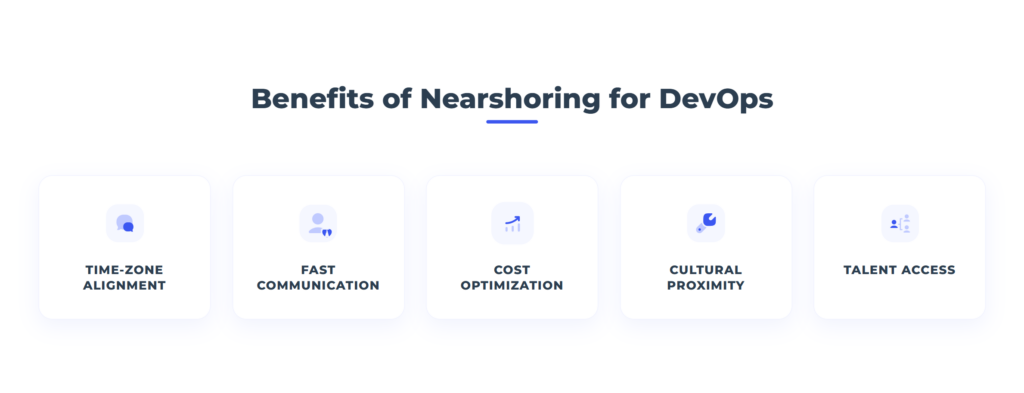
- Time-zone alignment: Easier real-time collaboration (standups, workshops, incident response).
- Faster communication and coordination: Fewer delays than offshoring across large time differences.
- Cost optimization: Often cheaper than hiring locally, though usually not as low-cost as far-off offshore destinations.
- Cultural and travel proximity: Easier to build relationships; shorter, cheaper travel for in-person sessions.
- Talent access: Broader hiring pool for specialized skills.
Nearshoring offers a better time to market and understanding of the market… because culturally we are similar or the same. – Krystian Kotynia, Delivery Manager at Relout
What are the downsides of nearshoring?
- Not always the cheapest option: Labor costs can be higher than far-shore offshoring.
- Vendor and operational risk: Quality, delivery, and continuity still depend on governance and partner capability.
- Legal and compliance considerations: Data protection, IP ownership, and employment regulations still need careful contracting.
Nearshore regions that are commonly used for DevOps
If you are in North America (US/Canada)
Most “nearshore” DevOps arrangements for US/Canada prioritize Latin America because business hours align well with ET/CT/MT/PT.
Typical nearshore choices:
- Mexico: strongest time-zone alignment for US/Canada; widely used as a nearshore option.
- Colombia / Costa Rica: frequently cited as emerging or established nearshoring hubs in the region (commonly used for IT services as well).
- Brazil: sometimes used as a nearshore hub (time-zone overlap is workable for many US teams, though not as tight as Mexico).
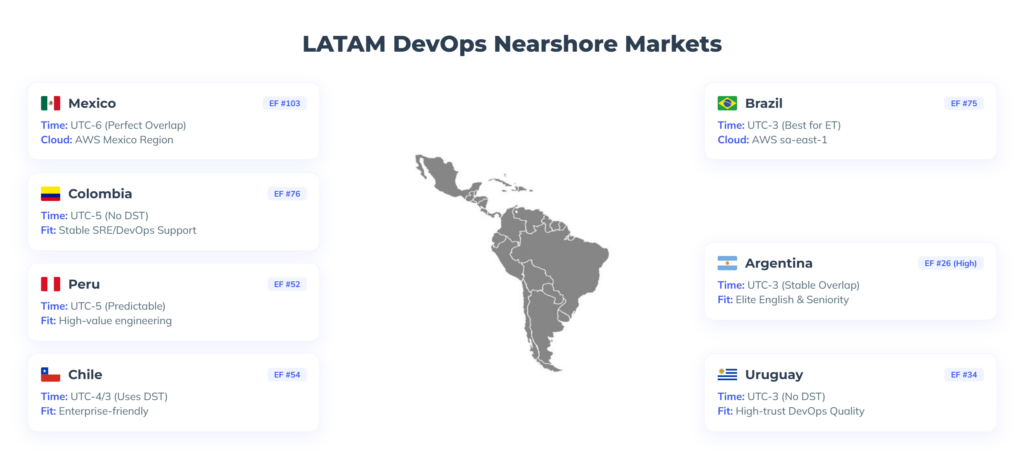
Here’s a comparison of popular Latin American nearshore destinations for US-based DevOps teams:
| Country | Time zone & DST (operational predictability) | Typical overlap with US hours | English proficiency (EF EPI) | Cloud / data-residency signals | Practical DevOps nearshore fit (US buyer) |
| Mexico | 4 time zones; most of the country is UTC−6, with DST generally discontinued nationally (exceptions in Baja California + some border municipalities). | Excellent for US teams (especially CT/ET). Border areas can align tightly with US DST. | #103, score 440 (Very Low). | AWS Mexico (Central) Region (mx-central-1) is generally available (3 AZs). | Strong option when time-zone alignment and onsite/nearby travel matter. English level varies heavily by city/company; vet directly. |
| Colombia | Single time zone UTC−5, no DST. | Strong overlap with ET/CT. | #76, score 480. | Typically relies on US cloud regions; local colocation exists but hyperscaler “region” presence is more limited than Brazil/Mexico. | Good for stable hours + collaboration; widely used for nearshore DevOps/SRE support. |
| Peru | Single time zone UTC−5, no DST. | Strong overlap with ET/CT. | #52, score 519. | Typically relies on US cloud regions. | Solid option if you want predictable overlap and can recruit for English/Cloud depth by partner reputation. |
| Chile | Multiple zones; mainland uses DST (commonly shifts between UTC−4 and UTC−3). | Good overlap with ET/CT (slightly better during parts of the year depending on DST alignment). | #54, score 517. | AWS has announced a future Chile region (timelines depend on rollout). | Strong “enterprise-friendly” market; DST adds a small ops coordination cost. |
| Brazil | Multiple time zones; the main population centers are typically UTC−3; DST is not broadly observed currently. | Best for ET; weaker for PT. | #75, score 482. | AWS South America (São Paulo) Region exists (sa-east-1). | Biggest talent market in the region; language is Portuguese (team onboarding + docs/ops comms need attention). |
| Argentina | Single time zone UTC−3, no DST. | Decent overlap with ET; less with PT. | #26, score 575 (High). | Typically relies on US cloud regions; strong engineering talent pool. | Strong for English + senior engineering, with operational predictability; ensure commercial/risk controls in contracting. |
| Uruguay | Single time zone UTC−3, no DST. Time and Date | Decent overlap with ET; less with PT. | #34, score 542. ef.com | Typically relies on US cloud regions. | Smaller market but often strong for quality + English, good for “high-trust” DevOps teams when you don’t need huge scale. |
If you need true 24/7 coverage but want to avoid burning out a single team with night shifts, a practical approach is a follow-the-sun model: you keep primary hours covered by a nearshore team (for example, LATAM for the US), and add a second region for after-hours coverage. For many organizations, that second “anchor” is offshoring to Poland–despite the distance, Poland still provides workable overlap with North America. It’s roughly 4–6 hours with EST, 3–4 hours with CST, and 1–3 hours with PST, which is typically enough for daily syncs, planning, and escalation without relying on blind handoffs.
In this setup, Relout helps in two key ways:
- Operational resilience without night rotations
A Poland-based team can take on a meaningful share of operational and incident-response work during windows that fall into late afternoon or evening in North America, reducing the need for overnight coverage on one side. The overlap also makes joint triage and escalation significantly easier. - Predictable budgeting (often the biggest concern with offshoring)
Relout addresses the standard procurement/finance question: “How do we compare an hourly rate to the annual cost of an employee?” Our article proposes a simple budgeting method for the Polish B2B model: Annual Cost = Hourly Rate × 8 × ~230 days (since there were ~230 billable days for 2025 in Poland). This removes many hidden employer-side costs typically present with local hires (e.g., public holidays, PTO, benefits, payroll taxes, HR, recruitment, onboarding) and that you pay only for actual hours worked–making forecasting easier. We also offer a low-risk start option (a 14-day trial).
If you are in Europe
Europe-based nearshoring often focuses on Central/Eastern Europe and Southern Europe to keep overlap with CET/CEST and simplify travel and governance.
Typical nearshore choices:
- Central/Eastern Europe (e.g., Poland, Romania, Baltics, etc.): commonly referenced in Europe’s IT nearshoring landscape.
- Poland / Portugal: frequently cited as leading IT nearshoring destinations (different cost/talent profiles, both with strong EU accessibility).
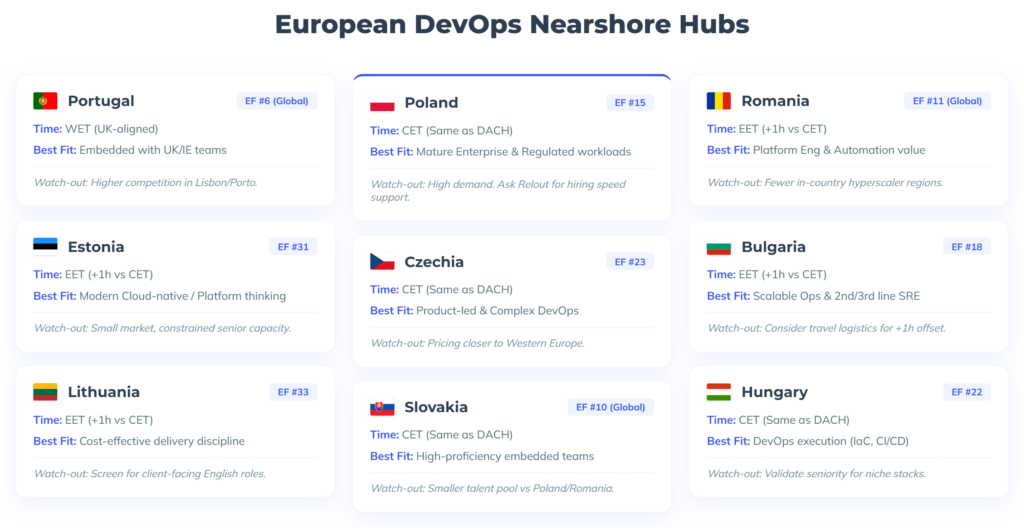
Here’s a comparison of popular European nearshore destinations for EU-based DevOps teams:
European nearshore destinations (DevOps focus) – quick comparison
| Destination | Time zone vs Western Europe | English proficiency (EF EPI 2025) | Best fit for DevOps nearshoring | Watch-outs |
| Poland | CET/CEST (same as DACH) | Score 600, global rank #15 | Mature DevOps market; strong enterprise delivery; good for regulated workloads needing EU delivery + strong process | Higher cost than some CEE alternatives; high demand can affect hiring speed – ask Relout for help |
| Romania | EET/EEST (typically +1h vs DACH) | Score 605, global rank #11 | Strong engineering talent and service culture; good value for platform engineering + automation | Fewer hyperscaler “in-country” region options; verify data-residency expectations early |
| Czechia | CET/CEST | Score 582, global rank #23 | Good fit for complex DevOps in product-led environments; strong proximity/culture match for DACH | Often priced closer to Western Europe than “budget” nearshore options |
| Slovakia | CET/CEST | Score 606, global rank #10 | High English score; good for embedded DevOps teams with Western EU hours | Smaller talent pool vs Poland/Romania–key roles may take longer to staff |
| Hungary | CET/CEST | Score 590, global rank #22 | Solid for DevOps execution work (IaC, CI/CD, observability) with CET overlap | Validate senior-level availability for niche stacks; market can be “spiky” by city |
| Bulgaria | EET/EEST | Score 594, global rank #18 | Often strong value; good for scalable ops, monitoring, tooling, 2nd/3rd line SRE | If you need heavy onsite collaboration, consider travel/time logistics (+1h vs CET) |
| Portugal | WET/WEST (UK-aligned; typically -1h vs CET) | Score 612, global rank #6 | Great English + strong collaboration; good for DevOps embedded with UK/IE teams | Can be pricier than parts of CEE; talent competition in Lisbon/Porto |
| Estonia | EET/EEST | Score 561, global rank #31 | Strong digital mindset; good for modern cloud-native practices and platform thinking | Small market; senior DevOps capacity can be constrained–plan staffing early |
| Lithuania | EET/EEST | Score 543, global rank #33 | Works well for cost-effective nearshore teams with solid delivery discipline | English score is lower than top CEE options–screen for client-facing roles |
DevOps outsourcing models that work well with nearshoring
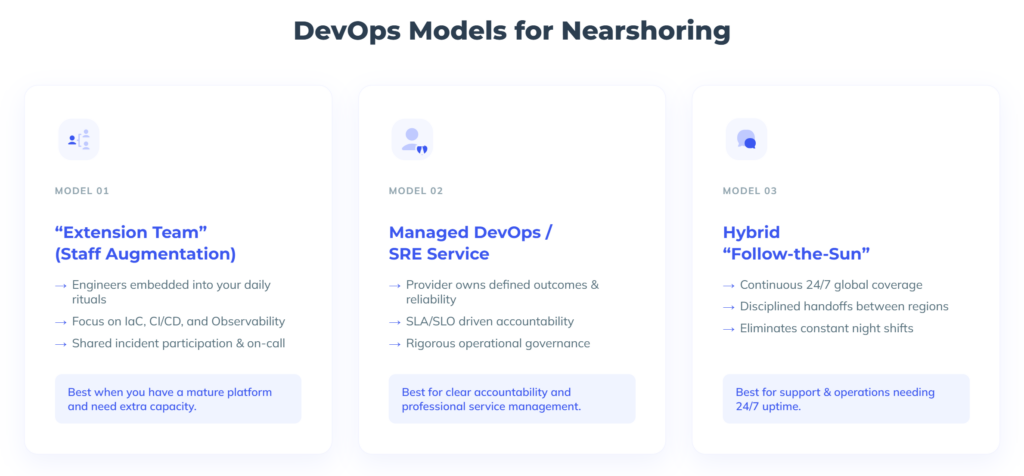
1) “Extension team” (staff augmentation)
You keep architecture and accountability in-house; the nearshore team provides engineers embedded into your rituals:
- daily ops, IaC, CI/CD, observability
- incident participation and on-call (often shared)
Best when you already have a mature platform and want capacity.
2) Managed DevOps / SRE service
Provider owns defined outcomes (e.g., platform reliability, on-call response, pipeline uptime) under SLAs/SLOs:
- clearer accountability
- requires more rigorous contracting and operational governance
Best when you want a single throat to choke and can invest in good service management.
3) Hybrid “follow-the-sun” (if you truly need 24/7)
Nearshore covers primary hours; another region covers nights; you run disciplined handoffs. This is common in support/operations models to maintain continuous coverage without constant night shifts.
Nearshored DevOps: what to specify up front (to avoid predictable failure modes)
If you outsource DevOps, the contract and operating model should be explicit on:
- On-call design: hours covered, paging policy, escalation paths, and whether the vendor is L1/L2/L3
- SLOs/SLIs and error budgets: what “good” looks like (availability, latency, deploy success rate, MTTR)
- Access controls: least privilege, break-glass process, audit logging (especially for prod cloud accounts)
- Change management: deployment windows, approvals, rollback standards
- Runbooks and documentation: required artifacts, review cadence, ownership
- Security/compliance: data handling, incident reporting timelines, audit support (SOC 2 / ISO 27001 as applicable)
- Tooling: cloud (AWS/Azure/GCP), IaC (Terraform/Pulumi), CI/CD (GitHub Actions/GitLab/Jenkins), observability (Datadog/Prometheus/Grafana), ITSM (Jira/ServiceNow)
Practical “default” setups
- US/Canada nearshore: Latin America team provides daytime operations aligned to ET/CT (incidents + changes), with either (a) rotating after-hours onshore coverage or (b) a second region for overnight follow-the-sun.
- Europe nearshore: Central/Eastern Europe + (optionally) Southern Europe provides strong overlap with CET/CEST; easiest governance if you want EU-friendly compliance and travel.
Need help with nearshoring to Poland?
Relout specializes in outsourcing top Polish IT talent. We’re sure we can deliver developers that will fit your needs – so much so we provide a 14-day trial period for new consultants. Contact us today.
DevOps Nearshoring FAQ
Nearshoring in DevOps refers to outsourcing engineering or operations tasks to a nearby country, typically within a few time zones of the client, to enable real-time collaboration and reduce communication delays.
– Onshoring keeps work within the same country.
– Nearshoring sends work to a nearby country with similar business hours.
– Offshoring moves work to distant regions, often with limited time-zone overlap.
Nearshoring offers time-zone alignment, faster communication, lower costs than local hires, cultural proximity, and access to specialized talent without the extreme time gaps of offshoring.
Popular nearshore destinations for US companies include Mexico, Colombia, Brazil, Peru, Argentina, and Uruguay due to strong time-zone alignment and growing DevOps talent pools.
Top choices include Poland, Romania, Czechia, Portugal, and the Baltics–offering high English proficiency, strong engineering talent, and time-zone compatibility with Western Europe.
A follow-the-sun model divides operations across global teams to provide 24/7 coverage without night shifts. For example, a US team might nearshore to LATAM and offshore to Poland for round-the-clock incident response.
Key elements include: on-call responsibilities, service level objectives (SLOs), access controls, change management processes, runbooks, compliance requirements, and tooling compatibility.
https://www.timeanddate.com/time/zone/
https://www.ef.com/wwen/epi/
https://aws.amazon.com/blogs/aws/now-open-aws-mexico-central-region
https://aws.amazon.com/about-aws/global-infrastructure
https://aws.amazon.com/pt/local/saopaulo/