Talent acquisition is a strategic, long-term approach to finding, hiring, and retaining people based on business goals – not just filling an empty seat. Unlike traditional recruitment, which often reacts to vacancies, talent acquisition focuses on proactive sourcing, workforce planning, and ongoing talent management to reduce downtime, improve fit, and protect delivery.
At Relout, we apply this model to help teams scale reliably – especially in remote and distributed environments – by treating hiring as an ongoing system rather than a one-off transaction.
| Relout helps tech companies hire and retain specialists with a full-cycle talent model: sourcing in Poland, technical checks by senior engineers, structured onboarding, and ongoing talent management. The goal is to cut delivery risk, speed up hiring, and keep teams stable, not treat hiring as a one-time task. |
What is talent acquisition?
Talent acquisition (TA) is a long-game hiring strategy designed to ensure a company consistently has the skills it needs to deliver. It combines
- proactive sourcing,
- role design,
- technical verification,
- onboarding support, and
- retention practices
so hiring outcomes stay aligned with product and business priorities over time.
Why is talent acquisition better than traditional recruitment?
Traditional recruitment is often built around urgency: a person leaves, a role opens, and the goal becomes “replace them fast.” Talent acquisition prevents that cycle by building a pipeline before the pressure hits.
In-house recruitment can also be expensive when you factor in:
- recruiter payroll and tooling
- time spent interviewing by senior engineers
- the operational cost of an unfilled role in a critical project
When a key position stays open, the impact is rarely limited to missing capacity. Delivery slows, bottlenecks harden, technical debt increases, and business continuity can be put at risk.
| Dimension | Typical recruitment (reactive) | Talent acquisition (strategic) |
|---|---|---|
| Primary goal | Fill an open role quickly | Build long-term capability aligned to business goals |
| Trigger | Vacancy (someone leaves, project starts) | Workforce planning (roadmap, skill gaps, risk) |
| Time horizon | Short-term | Long-term |
| Candidate pipeline | Built per role, then resets | Maintained continuously (warm talent pool) |
| Role definition | Often based on job title + checklist | Based on outcomes, context, and team constraints |
| Sourcing approach | Job ads + limited network | Proactive sourcing, headhunting, market mapping |
| Screening focus | CV + general fit | Technical validation + remote/async collaboration fit |
| Stakeholder involvement | Mostly HR/recruiter-led | Cross-functional (HR + hiring manager + technical leaders) |
| Success metric | Time-to-fill | Quality-of-hire, retention, delivery continuity |
| Common risk | Mis-hire under pressure, repeated rehiring | More upfront planning, but fewer surprises later |
What does it cost when a developer role stays unfilled?
The biggest hiring cost is often the time lost while a role is vacant.
- $1k+ per day: According to data from DockYard, a typical software engineering vacancy in a tech-driven company can cost as much as $1,082.25 per day when factoring in the specific revenue-generating potential of an engineer versus the overhead of the search.
What makes talent acquisition a proactive hiring model?
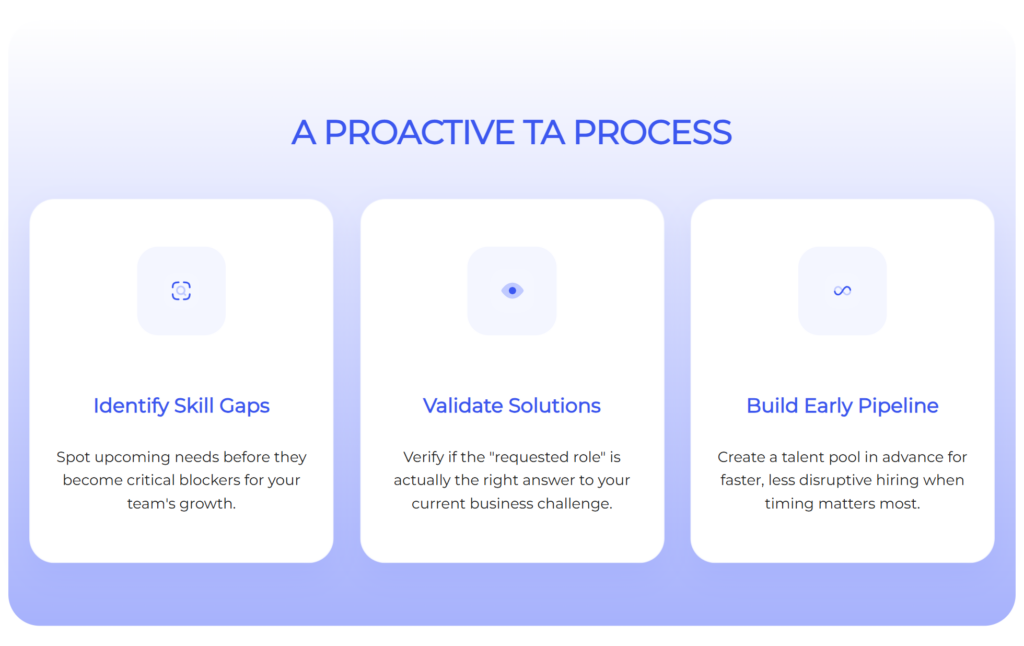
A reactive model starts with a vacancy. A proactive model starts with risk and roadmap.
In practice, a proactive TA process:
- identifies upcoming skill gaps before they become blockers
- validates whether the “requested role” is actually the right solution
- builds a pipeline early – so hiring is faster and less disruptive when timing matters
A common pattern in tech hiring is misdiagnosis: a company asks for “a senior developer,” but deeper technical analysis reveals the real need is a niche specialist – or a split role where two people can own different responsibilities cleanly.
At Relout, technical leadership is involved early when needed. The goal is to solve the underlying engineering constraint (architecture, infrastructure, ownership, scalability), not just fill a title.
Relout approach: diagnose before you hire
When needed, Relout brings technical leadership into early client conversations to validate the real constraint behind a request. If the bottleneck is cloud ownership, platform reliability, or architecture debt, we’ll recommend the role shape that solves the problem—even if that means splitting responsibilities across two specialists rather than hiring a single “do-everything” profile.
What are the core components of talent acquisition?
The core elements of a strong talent acquisition system include:
- Proactive sourcing and headhunting
- Role definition and long-term workforce planning
- Technical and cultural verification
- Talent pool development
- Structured onboarding and delivery support
- Retention and engagement practices
- Ongoing client service and quality control
Where Relout adds value
Companies typically partner with Relout when they need a hiring system that’s faster than in-house recruitment and more accountable than ad-hoc staffing. We’re set up to help with:
- Proactive sourcing and headhunting for niche stacks (not just job ads)
- Technical validation supported by senior engineering leaders
- Remote-first hiring with emphasis on async communication and ownership
- Onboarding and ongoing support so delivery doesn’t drop after day one
- Retention-focused management to reduce rotation and protect continuity
Below is how these typically work in a tech-focused TA process.
How does proactive sourcing and headhunting work?
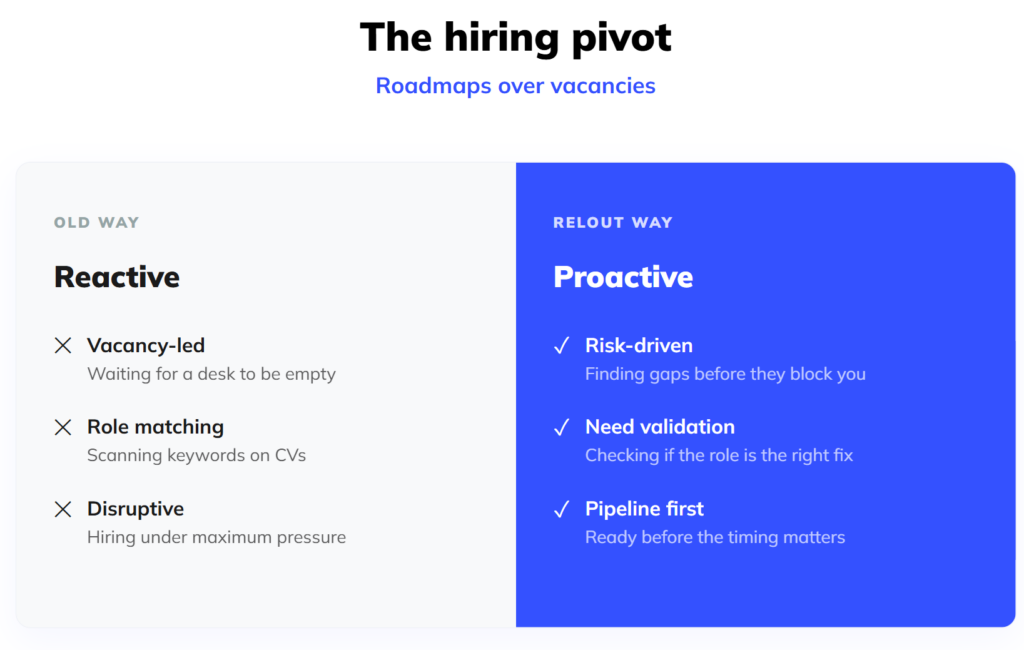
Proactive sourcing isn’t “posting and waiting.” It’s market mapping and targeted outreach.
A practical approach includes:
- mapping where the right profiles actually exist (by region, stack, seniority)
- checking supply realistically before committing to timelines
- designing outreach and screening around the real constraints of the role (not generic keywords)
For specialized work (e.g., migrations, niche cloud patterns, uncommon frameworks), this step prevents wasted cycles by clarifying whether the talent pool is deep – or scarce – before the search intensifies.
What is a talent briefing and why does it matter?
A talent briefing is a structured alignment process that defines the role in context, not just as a skill checklist.
A strong briefing answers:
- Why is the company hiring now?
- What broke down previously (if someone left)?
- What constraints exist in the current team (speed, quality, ownership, leadership)?
- What outcomes define success in 30/60/90 days?
This produces an “ideal candidate profile” that captures the why (business context) as much as the what (skills).
Be sure to check our free Talent Briefing template:

How do you verify technical fit and cultural fit – especially in remote teams
In remote work, execution quality depends heavily on communication and self-management – not just code.
Technical verification should confirm the candidate can handle:
- the specific stack and responsibilities (not just “similar experience”)
- decision-making and ownership expectations
- real-world tradeoffs (performance, maintainability, delivery constraints)
Cultural verification should test for:
- clarity in written communication (critical in async environments)
- reliability without constant supervision
- collaboration habits that work across time zones and limited synchronous time
Remote and on-site leadership need different habits. Copying office routines into chat tools often causes confusion, not alignment.
How do you build a talent pool instead of hiring one-off?
A talent pool is a maintained pipeline of candidates aligned to a specific business context.
For example, a frontend developer for:
- a fintech product (high compliance, risk-aware delivery, reliability) will often require a different mindset than
- a creative agency environment (fast iteration, presentation quality, frequent change)
A “made-to-measure” pool:
- keeps candidate relationships warm
- reduces time-to-hire for future roles
- improves match quality because the context is already understood
What does onboarding and ongoing management look like in talent acquisition
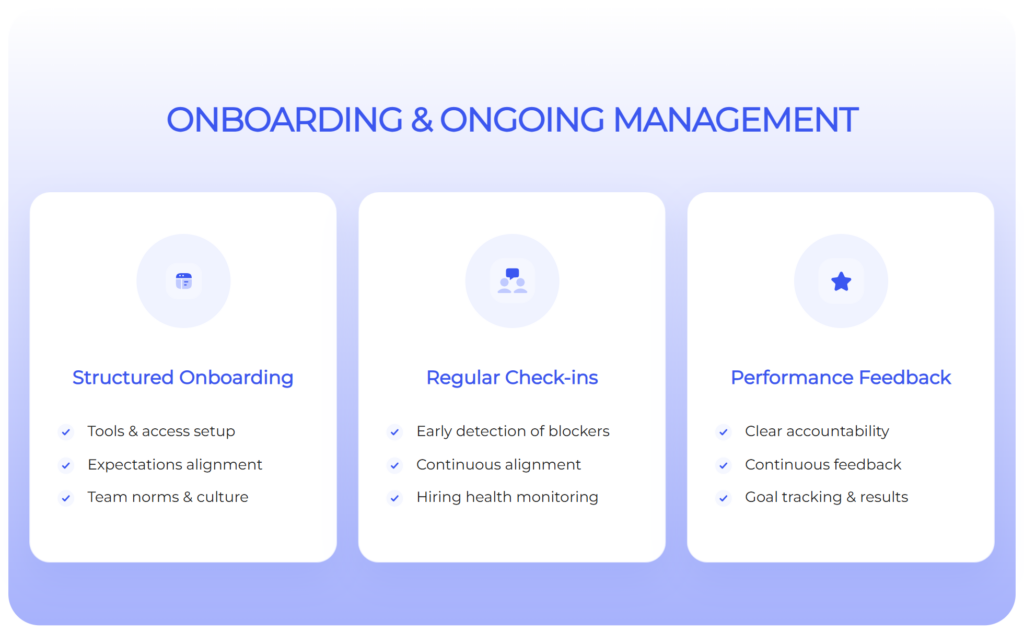
Talent acquisition doesn’t stop at “candidate accepted.”
A high-performing model includes:
- structured onboarding (tools, access, expectations, team norms)
- regular check-ins (early detection of blockers)
- performance feedback loops (clear expectations and accountability)
In practice, this reduces early churn and ensures delivery doesn’t depend on individual heroics.
How do retention and engagement reduce rotation?
Rotation is one of the fastest ways to lose momentum in product development.
Retention practices that reliably help:
- training budgets tied to role needs and growth paths
- wellbeing and sustainability support (especially in long remote engagements)
- transparent conversations about expectations, workload, and friction points
Some churn will always be driven by external factors (time zones, changing priorities, difficult delivery environments). TA aims to reduce preventable churn through better matching, better onboarding, and better support.
What does ongoing client service mean in a TA model?
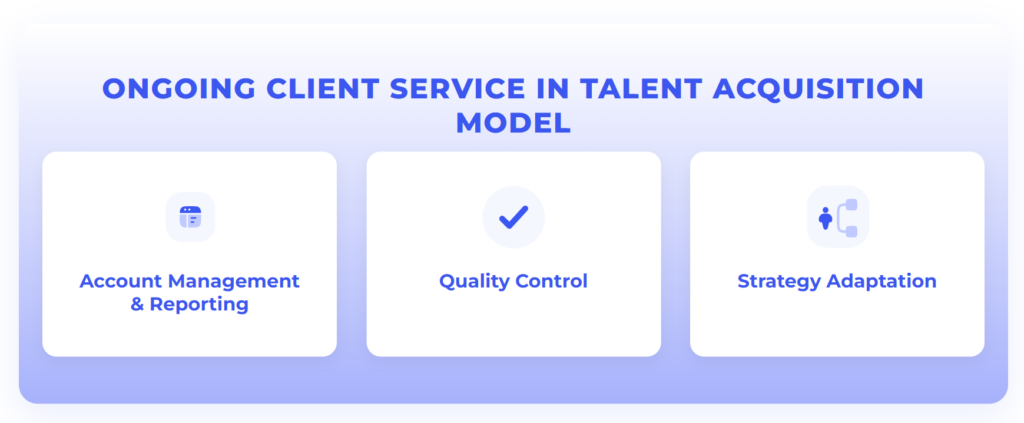
Client service is the operational backbone that keeps hiring outcomes stable over time. It typically includes:
- account management and reporting
- quality control across engagements
- adapting hiring strategy to market conditions (availability, salary ranges, demand shifts)
In other words: the system stays active even when there isn’t an urgent vacancy.
Want help building a proactive talent pipeline?
If you’re hiring for specialized engineering roles (especially in a remote or distributed setup), Relout can help you define the role properly, validate technical fit, and maintain a talent pipeline that reduces downtime and turnover. This is typically most valuable for teams where continuity matters and hiring is not a one-time event.
Talent acquisition FAQ
Talent acquisition is a long-term strategy focused on workforce planning, proactive sourcing, and retention. Recruitment is typically a short-term response to immediate vacancies.
It can look more involved upfront, but it often lowers long-term costs by reducing time-to-hire, minimizing downtime, and improving retention – especially in specialized tech roles.
Talent acquisition is most useful when hiring is continuous, roles are specialized, delivery depends on stable teams, or the company is scaling rapidly and wants predictable hiring outcomes.
Remote teams rely more on written communication, self-management, and clear ownership. TA processes typically add stronger screening for these factors and more structured onboarding to prevent misalignment.